TL;DR: Inverted MoSCoW
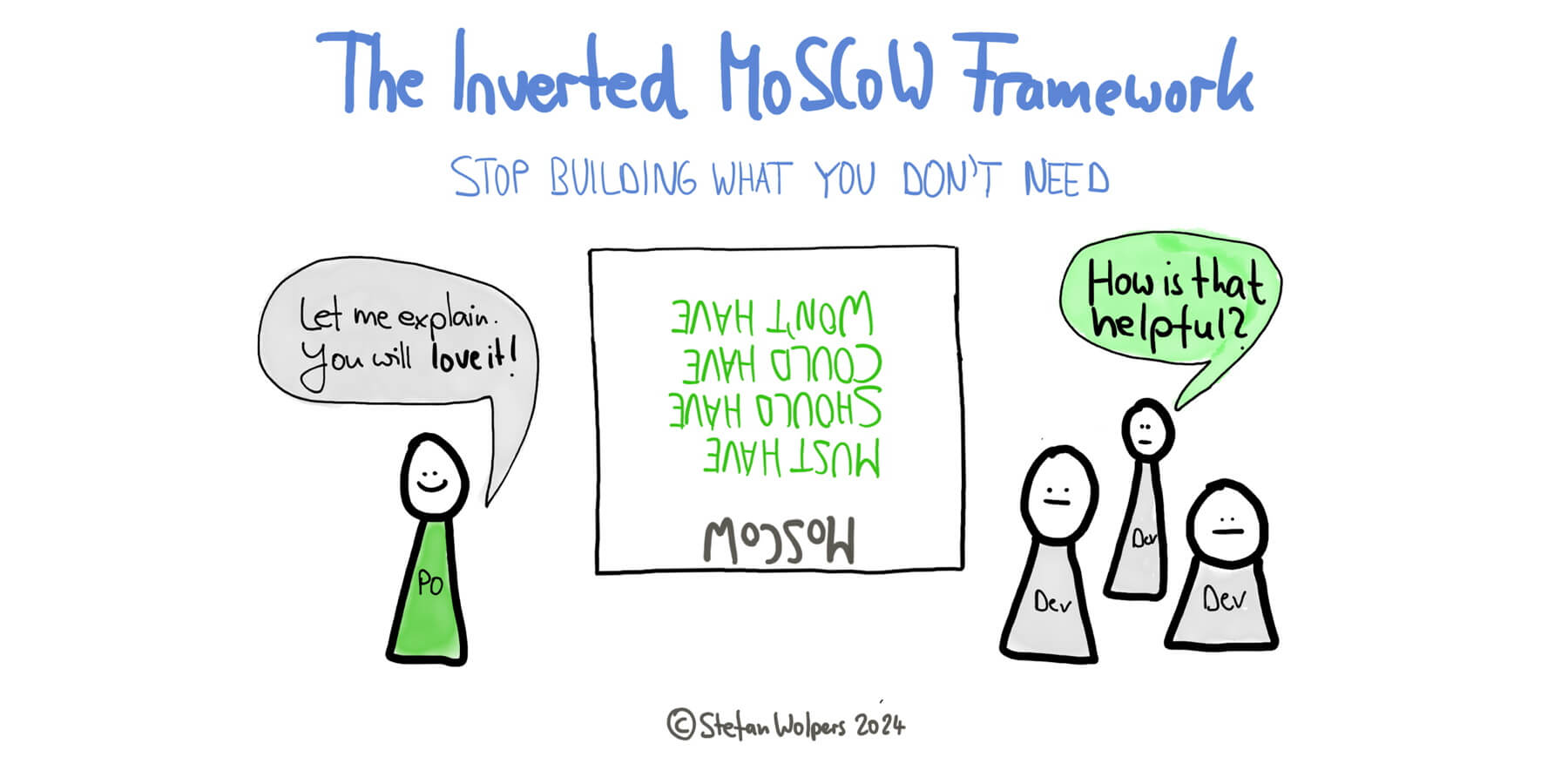
The inverted MoSCoW framework reverses traditional prioritization, focusing on what a product team won’t build rather than what it will. Deliberately excluding features helps teams streamline development, avoid scope creep, and maximize focus on what truly matters.
While it aligns with Agile principles of simplicity and efficiency, it also requires careful implementation to avoid rigidity, misalignment, or stifling innovation. Used thoughtfully, it’s a powerful tool for managing product scope and driving strategic clarity.
Read on and learn how to make the inverted MoSCoW framework work for your team.
January 27, 2025: The Advanced Product Backlog Management Course for Just $99!

Please note:
- The course includes membership in my former professional students’ brand-new Hands-on Agile community.
- The course will only be available for sign-up until February 3, 2025!
Shall I notify you about articles like this one? Awesome! You can sign up here for the ‘Food for Agile Thought’ newsletter and join 42,000-plus subscribers.
Join Stefan in one of his upcoming Professional Scrum training classes!
Starting with MoSCoW
The MoSCoW prioritization framework is a tool that helps product teams focus their efforts by categorizing work into four levels:
- Must-Have: These are non-negotiable requirements without which the software won’t function or meet its goals. Think of them as your product’s foundation. For example, a functional payment gateway is a “must-have” in an e-commerce app.
- Should-Have: These features add significant value but are not mission-critical. If time or resources are tight, these can be deferred without breaking the product. For example, a filtering option on a search page might enhance usability, but it isn’t essential to release the app.
- Could-Have: These are “nice-to-haves”—features that are not essential but would improve user experience if implemented. For example, animations or light/dark modes might fit here.
- Won’t-Have (this time): These are features explicitly deprioritized for this release cycle. They’re still documented but deferred for later consideration. For instance, integrating a recommendation engine for your MVP might be a “won’t-have.”
To learn more about the original MoSCoW framework, see the Wikipedia article or Chapter 10 of the DSDM Agile Project Framework manual.
MoSCoW Benefits
The MoSCoW framework offers significant benefits, including clarity and focus by distinguishing critical features from optional ones, which helps product teams prioritize effectively. It supports aligning development efforts with time, budget, and technical capacity constraints. Its adaptability allows teams to respond to changes quickly, dropping lower-priority items when necessary. Additionally, the framework fosters team alignment by creating a shared understanding across cross-functional groups, ensuring everyone works toward common goals.
MoSCoW Shortcomings
However, the MoSCoW framework also has notable shortcomings, including its tendency to oversimplify prioritization by overlooking nuances like feature dependencies, where a “must-have” might rely on a “could-have.”
It often lacks a quantitative assessment, relying instead on subjective judgments from stakeholders or leadership, which can misalign priorities by neglecting measurable impact or effort. Without solid discipline, it risks inflating the “must-have” category, overwhelming teams, and diluting focus. Additionally, the framework may emphasize output over outcomes, leading teams to prioritize delivering features without ensuring they achieve desired customer or business results.
Known MoSCoW anti-patterns are:
- Applied Without Strategic Context: When priorities are assigned without tying them to a clear product vision, business outcomes, or user needs, the framework becomes arbitrary. Ensure “must-haves” directly support critical business or customer goals.
- The “Must-Have Creep:” Stakeholders often push too many items into the “must-have” category. This undermines prioritization and can lead to overcommitment. Push back by asking: What happens if we don’t deliver this?
- Static Priorities: MoSCoW works best in an iterative context but can fail if teams treat the categories as rigid. Priorities should be reviewed frequently, especially during discovery phases or as new constraints emerge.
- Ignoring Dependencies: A feature might seem low-priority but could block a higher-priority item. Consequently, technical dependencies should always be considered during prioritization.
- Siloed Decision-Making: If product managers assign priorities without consulting developers, it may lead to technical infeasibilities or underestimating the complexity of “must-haves.”
Turning MoSCoW Upside Down — Meet the Inverted MoSCoW
Let’s run a little thought experiment: Do you remember the principle of the Agile Manifesto that “Simplicity–the art of maximizing the amount of work not done–is essential?” (Source.)
So, why not turn MoSCoW upside down?
The inverted MoSCoW framework flips the original framework, focusing primarily on what a product team will not build. Instead of prioritizing features or tasks to be included in a release, this approach emphasizes deliberate exclusions, helping teams identify and articulate boundaries. Here’s how it’s structured:
- Won’t-Have (Absolutely Not): Features or tasks explicitly ruled out for the foreseeable future. These could be ideas that don’t align with the product vision, are too costly or complex, or don’t deliver enough value. The debate ends here.
- Could-Have (But Unlikely): Features that might be considered someday but aren’t practical or impactful enough to be prioritized soon. They are low-value additions or enhancements with minimal urgency. Maybe we’ll get to them, perhaps we won’t—no promises.
- Should-Have (Under Very Specific Conditions): Features that might be built under exceptional circumstances. These could address edge cases, serve niche audiences, or depend on favorable future conditions, like extra resources or demand. Unless something significant changes, forget about them.
- Deferred Consideration (Maybe in the Future): These features or improvements are explicitly out of scope. The team acknowledges they may be somewhat important but intentionally excludes them, for now, to stay focused on core objectives.
What Are the Benefits of an Inverted MoSCoW?
Turning the original on its head has several advantages as we change the perspective and gain new insights:
- Aligns with Agile’s Simplicity Principle: The inverted MoSCoW approach reinforces Agile’s focus on maximizing the amount of work not done. By prioritizing exclusions, it ensures the team spends its energy on the most valuable and impactful work.
- Improves Focus and Efficiency: Defining what will not be built reduces distraction, scope creep, and debate during development. Teams avoid wasting time on “shiny object” features that may feel exciting but offer limited value.
- Encourages Strategic Restraint: By explicitly stating exclusions, the inverted framework helps ensure resources are allocated to problems that matter most. It also guards against overpromising or committing to ideas that lack clear value.
- Facilitates Transparent Communication: Stakeholders often feel disappointed when their ideas aren’t included. The inverted structure clarifies why specific ideas are excluded, fostering alignment and reducing conflict.
- Enables Long-Term Thinking: Teams can park features or ideas in “Could-Have (But Unlikely)” or “Must-Have (Future Consideration)” categories, ensuring they remain documented without distracting from immediate priorities.
- Prevents Cognitive Overload: Developers and product teams can stay laser-focused on what matters most without getting bogged down by debates over “extras.” It simplifies decision-making by narrowing the scope upfront.
If we compare both approaches in a simplified version, it would look like this:
| Aspect |
Original MoSCoW |
Inverted MoSCoW |
| Focus |
What will be built |
What won’t be built |
| Approach |
Inclusion-oriented |
Exclusion-oriented |
| Goal |
Maximize delivery of prioritized features |
Minimize waste and distractions |
| Stakeholder Role |
Define priorities collaboratively |
Understand and accept exclusions |
| Scope Creep Risk |
Medium – “Should/Could” items may creep into work |
Low – Explicitly avoids unnecessary features |
| Alignment with Agile |
Supports incremental delivery |
Embraces simplicity and focus |
“Flipping MoSCoW” aligns with Agile principles by minimizing unnecessary work, improving focus, and reducing cognitive overload. It fosters transparent communication, encourages strategic restraint, and documents ideas for future consideration, ensuring product teams target what truly matters. By anchoring exclusions in product vision, engaging stakeholders early, and revisiting decisions regularly, teams can avoid scope creep and manage expectations effectively while maintaining flexibility to adapt.
Practical Steps to Use the Inverted MoSCoW Framework
If you were to use the inverted MoSCoW framework to identify valuable work, consider the following practical steps to familiarize team members and stakeholders with the approach and get the communication right:
- Start with Product Vision and Strategy: Anchor exclusions in the product vision and strategy. For example, if you want to create a lightweight, user-friendly app, explicitly rule out features that add unnecessary complexity or bloat.
- Engage Stakeholders Early: Discuss exclusions with stakeholders upfront to set expectations and reduce future conflict. Use the inverted framework to clarify decisions to avoid being considered a black hole for decisions or simple “nay-sayers” by stakeholders.
- Build a Backlog of Exclusions — an Anti-Product Backlog: Maintain a list of features that won’t be built. This anti-product backlog serves as a transparent guide for future discussions.
- Revisit Regularly: Just as priorities can shift, so can exclusions. Reassess your “Could-Have” and “Should-Have” lists periodically to determine if conditions have changed — inspection and adaption will be crucial to maximizing value creation within the given constraints by the organization.
- Document the Rationale: For every exclusion, document why it was made, as they are dynamic and context-dependent. This context helps prevent revisiting the same debates and ensures alignment across teams and stakeholders. What isn’t feasible or aligned today might become critical in the future. Keep an archive of exclusions and periodically reassess them.
Moreover, it would be helpful to consider applying complementary practices with the inverted MoSCoW framework, for example:
- Combine Frameworks for Robust Prioritization: Pair the inverted MoSCoW framework with other tools like Impact-Effort Matrices to identify low-effort, high-impact features that might deserve reconsideration or Opportunity Solution Trees to visualize how exclusions align with overarching goals.
- Use Prototyping and Experimentation: Validate an idea’s potential impact through lightweight prototypes or experiments before ruling it out. This ensures that promising concepts aren’t prematurely excluded.
Also, expect practical challenges you will have to address when utilizing the inverted MoSCoW framework, for example:
- Resistance to Exclusions: Stakeholders often struggle to accept that their ideas are being excluded. To counter this, frame exclusions positively—focus on the value of prioritization and the benefits of delivering a lean, focused product.
- Exclusions as “Final Decisions:” Exclusions aren’t permanent. They’re tools for managing focus and scope at a specific moment. Encourage teams to view them as flexible and open to reassessment.
- Balance Between Focus and Innovation: While the framework promotes clarity and efficiency, excessive focus on exclusions can hinder creative exploration. Reserve space for continuous product discovery to keep the product competitive.
Drawbacks of the Inverted MoSCoW Framework
The inverted MoSCoW framework is valuable for defining what a product team will not build, helping teams focus on simplicity and efficiency. However, like its traditional counterpart, it is not without flaws.
One significant challenge is the subjectivity in deciding exclusions. Stakeholders may struggle to align on what belongs in the “Won’t-Have” category, leading to potential conflicts or misaligned expectations. Without clear, objective criteria for exclusions, decisions risk being arbitrary or biased, undermining strategic goals and damaging team cohesion.
Another critique is the framework’s tendency to encourage over-simplicity, which can stifle innovation or long-term thinking. While focusing on “not building” aligns with Agile principles of simplicity, over-prioritizing exclusions can narrow the product’s scope too much, leaving teams unprepared for future opportunities or changing market conditions. Balancing exclusions with flexibility is crucial, ensuring ideas with strategic potential aren’t entirely dismissed but appropriately categorized for future consideration.
The framework also struggles to account for dependencies between excluded and included features. Excluding a “Won’t-Have” feature without understanding its role in supporting other work can inadvertently disrupt development, causing delays or requiring rework. Similarly, failing to consider effort or complexity in exclusions may result in missed opportunities to deliver low-effort, high-impact features. Teams must evaluate dependencies and efforts to ensure exclusions don’t inadvertently hinder progress or innovation.
Finally, the inverted MoSCoW framework can become rigid, especially in agile, iterative environments where priorities shift rapidly. Exclusions defined early may no longer align with emerging user needs or business goals, creating tension between strategic intent and practical reality. To mitigate this, teams must treat exclusions as dynamic, revisiting and reassessing them regularly to ensure they remain relevant and effective. By addressing these critiques, the inverted MoSCoW framework can remain a powerful tool for managing focus and simplicity without sacrificing flexibility or strategic foresight.
Conclusion
The inverted MoSCoW framework is a powerful tool but is most effective as part of a broader prioritization strategy. By emphasizing collaboration, grounding decisions in data, and maintaining flexibility, you can ensure that exclusions support—not hinder—your product’s long-term success. Keep iterating, communicating, and aligning decisions with strategic goals, and the framework will serve as a valuable ally in your product development efforts.
How does your product team decide on what not to build? Please share your ideas with us in the comments.
Related Articles
Stefan Wolpers: The Scrum Anti-Patterns Guide (Affiliate advertisement at no cost to you.)
Alignment Tools: Creating Better Relationships Between Stakeholders and Teams
27 Product Backlog and Refinement Anti-Patterns
Product Washing: The Pitfalls of a Superficial Product Operating Model Transformation
Agile Negotiations
11 Proven Stakeholder Communication Tactics during an Agile Transition
Transformation to Agile Primitives: Rebuilding Agility from the Ground Up
Agile Failure Patterns in Organizations 2.0
Download the Scrum Anti-Patterns Guide for free
Scrum Training Classes, Workshops, and Events
Learn more about the Inverted MoSCoW Framework with our Scrum training classes, workshops, and events. You can secure your seat directly by following the corresponding link in the table below:
| Date |
Class and Language |
City |
Price |
| December 10-11, 2024 |
Guaranteed: Professional Scrum Product Owner Training (PSPO I; German; Live Virtual Class) |
Live Virtual Class |
€1.299 incl. 19% VAT |
| December 12, 2024 |
Guaranteed: Professional Product Discovery and Validation Class (PPDV; German; Live Virtual Class) |
Live Virtual Class |
€749 incl. 19% VAT |
| December 18-19, 2024 |
Guaranteed: Professional Scrum Master Advanced Training (PSM II; English; Live Virtual Class) |
Live Virtual Class |
€1.299 incl. 19% VAT |
| January 28-31, 2025 |
Professional Scrum Product Owner Training (PSPO I; German; Live Virtual Class) |
Live Virtual Class |
€1.299 incl. 19% VAT |
| February 4-6, 2025 |
GUARANTEED: Hands-on Agile 2025: From Concept-Based to Context-Based Agility (English) |
Live Virtual Conference |
FREE |
| February 12-13, 2025 |
Professional Scrum Master Advanced Training (PSM II; English; Live Virtual Class) |
Live Virtual Class |
€1.299 incl. 19% VAT |
| February 27, 2025 |
Professional Scrum Facilitation Skills Class (PSFS; English; Live Virtual Class) |
Live Virtual Class |
€749 incl. 19% VAT |
| March 6 to April 3, 2025 |
Align, Discover, Deliver: The Product Backlog Management Cohort Class (English; Live Virtual Class) |
Live Virtual Class |
€499 incl. 19% VAT |
| March 11-12, 2025 |
Professional Scrum Product Owner Training (PSPO I; German; Live Virtual Class) |
Live Virtual Class |
€1.299 incl. 19% VAT |
| March 26-27, 2025 |
Professional Scrum Master Advanced Training (PSM II; English; Live Virtual Class) |
Live Virtual Class |
€1.299 incl. 19% VAT |
See all upcoming classes here.

You can book your seat for the training directly by following the corresponding links to the ticket shop. If the procurement process of your organization requires a different purchasing process, please contact Berlin Product People GmbH directly.
✋ Do Not Miss Out and Learn more about the Inverted MoSCoW Framework — Join the 20,000-plus Strong ‘Hands-on Agile’ Slack Community
I invite you to join the “Hands-on Agile” Slack Community and enjoy the benefits of a fast-growing, vibrant community of agile practitioners from around the world.

If you would like to join all you have to do now is provide your credentials via this Google form, and I will sign you up. By the way, it’s free.
Prepare yourself for the Product Operating Model by studying the free Scrum Anti-Patterns Guide: