TL;DR: AI Transformation Failures
Organizations seem to fail their AI transformation using the same patterns that killed their Agile transformations: Performing demos instead of solving problems, buying tools before identifying needs, celebrating pilots that can’t scale, and measuring activity instead of outcomes.
These aren’t technology failures; they are organizational patterns of performing change instead of actually changing. Your advantage isn’t AI expertise; it’s pattern recognition from surviving Agile. Use it to spot theater, demand real problems before tools, insist on integration from day one, and measure actual value delivered.
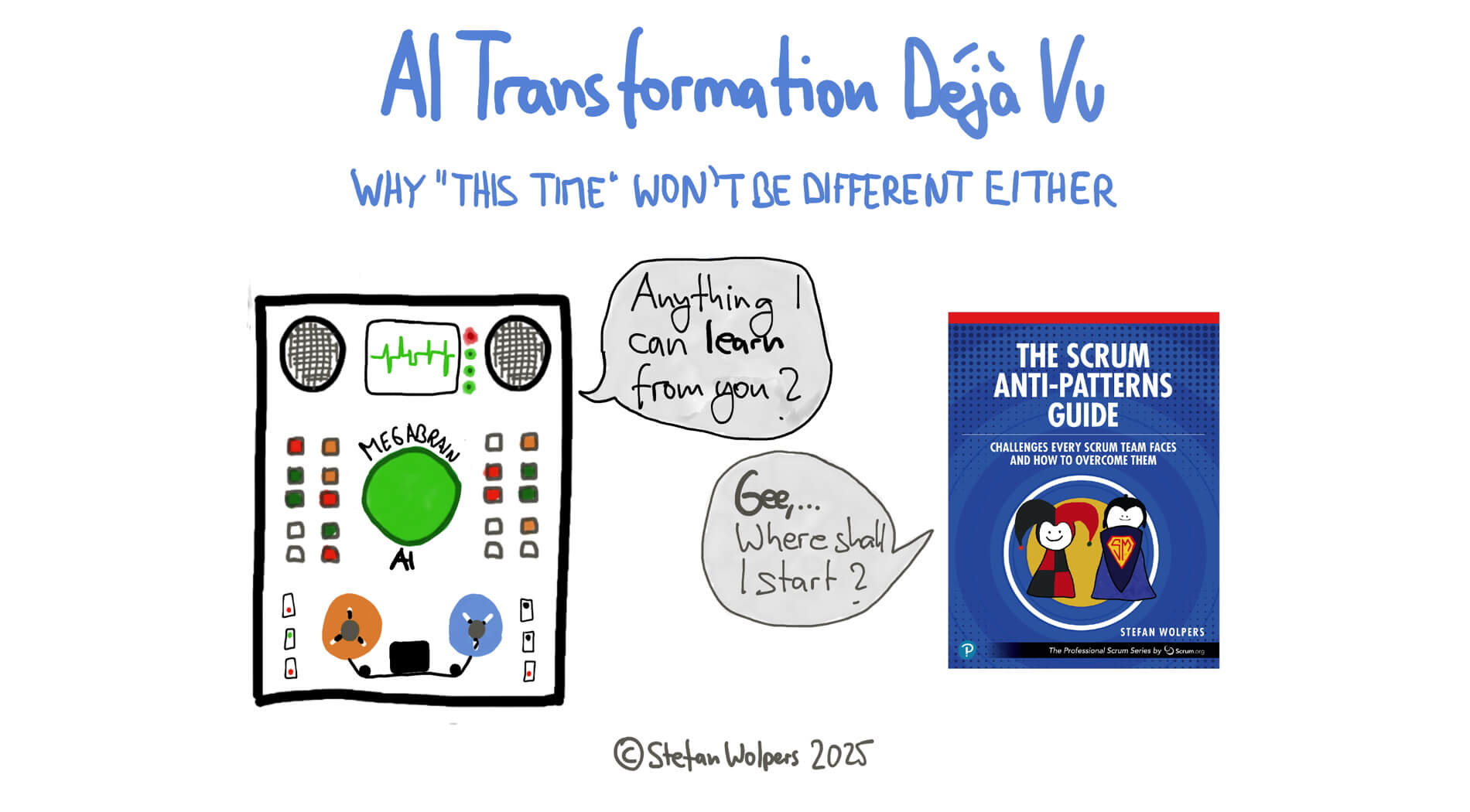
The AI 4 Agile Online Course at $129 — October 13, 2025
I developed the self-paced AI 4 Agile Online Course for agile practitioners, including Product Owners, Product Managers, Scrum Masters, Agile Coaches, and delivery professionals who want to integrate artificial intelligence into their workflows with clarity, ethics, and purpose.
You don’t need to become an AI expert. However, you do need to understand how LLMs like ChatGPT, Claude, or Gemini can support real agile work and where their limitations lie. Like Jim Highsmith said, AI isn’t just a tool, but a new context for agility.
This course shows you how to do precisely that.
What’s Included:
- 10+ hours of self-paced video modules
- A cohort-hardened, proven course design
- Learn to 10x your effectiveness with AI; your stakeholders will be grateful
- Delve into classic agile use cases of AI
- Help your team create more customer value
- All texts, slides, prompts, graphics; you name it
- Access custom GPTs, including the “Scrum Anti-Patterns Guide GTP”
- Enjoy community access for peer learning
- Guaranteed: Lifetime access to all course updates and materials; there is a lot more to come
- Certificate of completion.

Please note: The course will only be available for sign-up at $129 until October 20, 2025! ????
Join the Waitlist of the AI 4 Agile Online Course Now: Master AI Integration for Agile Practitioners—No AI Expertise Required!
Shall I notify you about articles like this one? Awesome! You can sign up here for the ‘Food for Agile Thought’ newsletter and join 40,000-plus subscribers.
Join Stefan in one of his upcoming Professional Scrum training classes!
The Same Movie With New Costumes
Organizations are failing their AI transformation in the same ways they failed their Agile transformations: Not in similar ways. In the same way.
The question is: why do we keep watching the same movie?
The Pattern That Keeps Repeating
Start with what we know happens. An organization announces its AI transformation. Leadership showcases demos of AI capabilities; impressive ones that generate real enthusiasm. Tools are evaluated and purchased. Metrics dashboards appear to track adoption rates. Pilot teams report spectacular results.
Then production reality hits. The demos don’t integrate with existing systems. The tools solve problems nobody actually has. The pilots can’t scale beyond their controlled environments. The metrics show 87% adoption while business outcomes remain unchanged. This sequence isn’t random. It’s structural.
When organizations need to appear innovative, they optimize for what’s visible rather than what’s valuable. Demos are visible. Integration work isn’t. Tool purchases are visible. Problem analysis isn’t. Adoption metrics are visible. Business outcomes are messier.
You lived this with Agile. Sprint Reviews became slide decks instead of collaboration with customers and stakeholders in real-time on working software. Teams spent months configuring Jira while their actual workflow problems went unaddressed. Velocity charts showed steady progress while customers saw no change in delivery speed or quality. (As it turns out, velocity is the easiest metric to manipulate.)
The costume changed. The performance didn’t.
Cannot see the form? Please click here.
Why Organizations Perform Change Instead of Changing
There is a reason organizations default to theater: it is safer than transformation.
Real transformation requires admitting current approaches aren’t working. It requires changing power structures, incentives, and decision rights. It requires accepting failure as learning. Most importantly, it requires patience for messy, non-linear progress.
Performance is cleaner. You can schedule it, script it, and control it. You can show steadily improving metrics (even if those metrics are meaningless). You can claim success based on activity rather than outcomes. You can avoid the uncomfortable questions about why things aren’t actually changing.
Consider the “Definition of Done” parallel. In Scrum, teams under pressure often erode their Definition of Done, ultimately defining “done” as “demo-able at the Sprint Review” rather than “deployable.” (And if the latter happens, nevertheless, it requires a “known issues will be fixed later” label.) With AI, “ready” means “the model passes offline tests” rather than “the AI workflow produces safe, reproducible, valuable outcomes in production.” Both redefinitions serve the same purpose: they make it easier to claim success without achieving it.
The Four Acts of Transformation Theater
Act One: Tools to the Rescue!
Before identifying any specific problems, the organization evaluates platforms. Months of vendor comparisons, proof-of-concepts, and feature matrices. This feels like progress: there are meetings, decisions, and purchase orders. But it’s the same error as believing Jira configuration would create agility. Tools don’t transform organizations. Solving real problems transforms organizations.
Act Two: The Crack Pilot Team
A team working in isolation, with special resources and exemptions from standard constraints, achieves remarkable results. Their AI system processes documents 100x faster! Of course, it only works with their test data, bypasses security protocols, and ignores regulatory requirements. But those details don’t make it into the success story; just like those high-performing Agile teams whose success couldn’t survive their first contact with enterprise governance.
Act Three: All Metrics Show Green
Dashboards everywhere tracking adoption, usage, engagement. No tracking of problems solved, time saved, or value delivered. It’s velocity theater all over again: measuring activity because it’s easier than measuring outcomes. Teams learn quickly: generate the metrics that make management happy, regardless of actual impact.
Act Four: The Integration Collapse
Reality arrives; what rules supreme in the sandbox fails in practice: The AI solutions can’t access relevant production data. They don’t comply with regulations. They can’t handle real-world edge cases. The governance board won’t approve them. The run costs are unsustainable. The organization quietly abandons or drastically scales back the initiative, though the theater continues.
Reading the Signs
You don’t need AI expertise to spot these patterns. You need the pattern recognition you have already developed:
- When someone says “We’re using AI for…” but can’t show you the actual workflow in production, you’re watching AI theater.
- When problem statements trail tool decisions: “We bought OpenAI licenses, now what should we do with them?”—you’re watching the tool quest.
- When success stories come only from isolated teams with special conditions, you’re watching the miracle pilot.
- When dashboards track activity but no one can articulate business impact, you’re watching the metrics mirage.
The AI Transformation Alternative Path
Some organizations do get this right. They start with specific, measurable problems. They run short experiments with clear hypotheses. They measure outcomes, not activity. They integrate with existing systems from day one. They define explicit quality bars that include safety, legality, and operational readiness. This approach isn’t revolutionary. It is the empirical approach Agile was supposed to enable. The difference is in doing it instead of performing it.
You are probably reading this because you recognize the patterns. You have seen this movie before. You know how it ends. The question is what you will do about it.
You could play along with the theater because it is politically safer. You could become cynical and disengage. Or you could use your pattern recognition to ask the uncomfortable questions, insist on real problems before tool purchases, demand integration plans before pilots, and measure outcomes instead of activity. (Sounds familiar?)
You’re not being negative when you point out these patterns. You’re being empirical. The most valuable person in your AI transformation isn’t the prompt engineer. It is the practitioner who can say, “We’ve seen this pattern before, and here’s how it ends.” That’s you.
AI Transformation Failure — Conclusion
You have read this far because you remember “last time” and you do not believe in “this time will be different.” Maybe it was the tool evaluation committees that never asked, “What problem are we solving?” Perhaps it was the pilot teams freed from every organizational constraint, declaring victory. Maybe it was the dashboards tracking everything except value delivered.
Whatever it was, you recognized it. Not because you are an AI expert, but because you have lived through this before with Agile. That recognition is your competitive advantage. While others are mesmerized by the demos and the metrics and the promises, you can see the patterns. You know that “87% AI adoption” is the new “200% velocity improvement:” meaningless numbers that hide an absence of real change.
The patterns documented here aren’t warnings about what might happen. They are descriptions of what’s happening right now. The question isn’t whether your organization is performing these patterns. It is how many of them you are watching simultaneously.
But here is what is different this time: you are different. You have developed immunity to transformation theater through exposure. You can spot the difference between a demo and a deployment. You know what happens to pilots when they hit production constraints. You have seen metrics games before.
This gives you a choice. Not between supporting or opposing AI; that is a false binary. The choice is between performing a transformation (theater) and actually transforming. Between measuring adoption and measuring impact. Between isolated success and integrated delivery. The hardest part isn’t technical. It is political. Asking “what specific problem does this solve?” in a room excited about possibilities. Insisting on production constraints when everyone wants to see potential. Measuring outcomes when activities are easier to track.
These aren’t acts of resistance. They are acts of professionalism. You are not the skeptic who shoots down innovation. You are the practitioner who knows the difference between motion and progress. The transformation your organization needs isn’t about AI. It is about finally learning the lessons from every transformation that came before. The patterns won’t change until organizations stop rewarding theater over reality, activity over outcomes, and tools over problems.
You can’t change the whole system. But you can change your part of it. One real problem solved. One honest metric. One integrated solution. One voice in the meeting asking: “How is this different from when we did this with Agile?”
That voice matters more than you think. Because someone needs to say what everyone who survived the last transformation is thinking: we’ve seen this movie before, and we know how it ends. Unless, this time, we change the script.
AI Transformation Failure — Related Posts
Meta Prompting: Making AI Your Conversation Partner
The Statistical AI Parrot in Your Sprint: Why AI Won’t Replace Your Agile Team (and Why Ignoring It Is a Mistake)
Ethical AI in Agile: Four Guardrails Every Scrum Master Needs to Establish Now
Generative AI in Agile: A Strategic Career Decision
Contextual AI Integration for Agile Product Teams
Stefan Wolpers: The Scrum Anti-Patterns Guide (Amazon advertisement.)
Scrum Training Classes, Workshops, and Events
Learn more about the Meta Prompting with our AI and Scrum training classes, workshops, and events. You can secure your seat directly by following the corresponding link in the table below:
See all upcoming classes here.

You can book your seat for the training directly by following the corresponding links to the ticket shop. If your organization’s procurement process requires a different purchasing approach, please contact Berlin Product People GmbH directly.
✋ Do Not Miss Out and Learn more about the AI Transformation — Join the 20,000-plus Strong ‘Hands-on Agile’ Slack Community
I invite you to join the “Hands-on Agile” Slack Community and enjoy the benefits of a fast-growing, vibrant community of agile practitioners from around the world.

If you would like to join all you have to do now is provide your credentials via this Google form, and I will sign you up. By the way, it’s free.