TL;DR: The Agile Manifesto Anticipated AI
The Agile world is splitting into two camps: Those convinced AI will automate practitioners out of existence, and those dismissing it as another crypto-level fad. Both are wrong. The evidence reveals something far more interesting and urgent: Principles written in 2001, before anyone imagined GPT-Whatever, align remarkably well with the most transformative technology of recent years. This is not a coincidence. I believe it is proof that human-centric values transcend technological disruption; it is the Agile AI Manifesto.
The AI 4 Agile Online Course at $129 — October 13, 2025
I developed the self-paced AI 4 Agile Online Course for agile practitioners, including Product Owners, Product Managers, Scrum Masters, Agile Coaches, and delivery professionals who want to integrate artificial intelligence into their workflows with clarity, ethics, and purpose.
You don’t need to become an AI expert. However, you do need to understand how LLMs like ChatGPT, Claude, or Gemini can support real agile work and where their limitations lie. Like Jim Highsmith said, AI isn’t just a tool, but a new context for agility.
This course shows you how to do precisely that.
What’s Included:
- 10+ hours of self-paced video modules
- A cohort-hardened, proven course design
- Learn to 10x your effectiveness with AI; your stakeholders will be grateful
- Delve into classic agile use cases of AI
- Help your team create more customer value
- All texts, slides, prompts, graphics; you name it
- Access custom GPTs, including the “Scrum Anti-Patterns Guide GTP”
- Enjoy community access for peer learning
- Guaranteed: Lifetime access to all course updates and materials; there is a lot more to come
- Certificate of completion.

Please note: The course will only be available for sign-up at $129 until October 20, 2025! ????
Join the Waitlist of the AI 4 Agile Online Course Now: Master AI Integration for Agile Practitioners—No AI Expertise Required!
Shall I notify you about articles like this one? Awesome! You can sign up here for the ‘Food for Agile Thought’ newsletter and join 40,000-plus subscribers.
Join Stefan in one of his upcoming Professional Scrum training classes!
The Broken Debate
Walk into any Agile community event today, and you will encounter two opposing camps, each equally confident and equally wrong:
- The AI maximalists predict the imminent automation of Scrum Masters, Product Owners, and Agile Coaches. Chatbots are replacing consultants, facilitation is reduced to prompts, and human judgment is rendered obsolete.
- The AI luddites, on the other side, dismiss the entire phenomenon as “just another metaverse,” destined to join Web3 and NFTs in the technology graveyard.
Both groups make the same error. They treat AI as either a complete solution or a complete fiction. They miss what is actually happening in organizations right now: a change that neither replaces human expertise nor fades into irrelevance.
Why This Time Actually May Be Different
Web3 and Crypto, replacing traditional finance, and the metaverse, redefining human interaction; both technologies were solutions desperately seeking problems. Seriously, at no time did Agile practitioners wake up thinking, “If only I had a blockchain-based smart contract for my Sprint Goal.”
Generative AI addresses problems that Agile practitioners already experience daily, such as analyzing and categorizing vast amounts of customer feedback, identifying patterns across Retrospectives, and detecting market shifts buried in noise. The problems existed first. AI provides solutions.
In my consulting practice across European enterprises, Product Owners and Product Managers are using AI to complete discovery cycles several times faster, but only when they already know which questions to ask. Retrospectives that draw on AI-identified patterns across multiple Sprints surface systemic impediments that manual review often misses. These effects are not predictions; they are measurements.
Dell’Acqua et al. (2025) confirmed this with 776 professionals at Procter & Gamble [1]. Individuals with AI matched the performance of entire teams without AI. Teams with AI were significantly more likely to produce top-tier solutions. Both AI-enabled groups worked 12-16% faster.
The Alignment Nobody Expected
Here is what makes the Agile Manifesto’s relationship with AI genuinely remarkable. Principles articulated in 2001, before the advent of smartphones, cloud computing, and generative AI, align almost perfectly with how generative AI functions in 2024.
The research confirms three patterns that are observable. These patterns extend beyond individual use cases and apply across Scrum, Kanban, and Extreme Programming:
Pattern One: AI Enhances Preparation, Humans Make Decisions
The human-in-the-loop approach: AI prepares context, humans decide.AI analyzes feedback continuously, surfaces latent needs, and synthesizes insights. But humans judge which insights matter and decide what to build. Without that expertise, AI-generated synthesis remains useless data.
AI assists with code review and identifies complexity. However, humans ultimately determine whether software effectively solves customer problems. AI provides system insights. But teams navigate trade-offs and organizational constraints. The Manifesto’s principle that “the best architectures, requirements, and designs emerge from self-organizing teams” remains intact, as decision-making stays with humans who understand context and relationships.
Cannot see the form? Please click here.
Pattern Two: Continuous Feedback Goes from Aspiration to Operational Reality
“Welcome changing requirements, even late in development” sounds impossible because detecting and responding to change requires enormous information processing. AI makes this Agile Manifesto principle operationally viable at scale.
Customer collaboration becomes continuous rather than periodic when AI monitors behavioral patterns, sentiment, and support conversations in real-time. What required quarterly research cycles now happens weekly or daily: Market shifts surface through AI-powered pattern recognition across data sources too vast for manual analysis.
Teams make adaptation decisions informed by a comprehensive analysis rather than a gut feeling. “Our highest priority is to satisfy the customer” shifts from well-meaning intent to operational reality when you discover what satisfies customers faster than competitors can. (Isn’t that the essence of “Agile,” learning faster than the competition?)
Pattern Three: AI Makes Face-to-face Conversation Exponentially more Valuable
The Agile Manifesto declares, “face-to-face conversation is the most efficient and effective method of conveying information.” AI does not replace this. It makes it massively more valuable by handling information processing while humans focus on judgment, relationship-building, and collaborative decision-making.
The Scrum Masters or Agile Coaches who arrive at stakeholder meetings with an AI-synthesized analysis of political positions do not replace conversation. They transform it from information gathering to strategic negotiation. AI can identify the top five pain points. It cannot read the room during a tense meeting and know when to push versus when to back off. That is your moat.
Dell’Acqua et al. (2025) [1] found that people using AI reported higher positive emotions and lower negative emotions. When AI removes information processing burden, humans focus more effectively on relationship work. Teams using AI for customer analysis have richer conversations, not fewer. The Agile Manifesto got it right: human conversation is irreplaceable.
The Contrarian Position Nobody’s Voicing
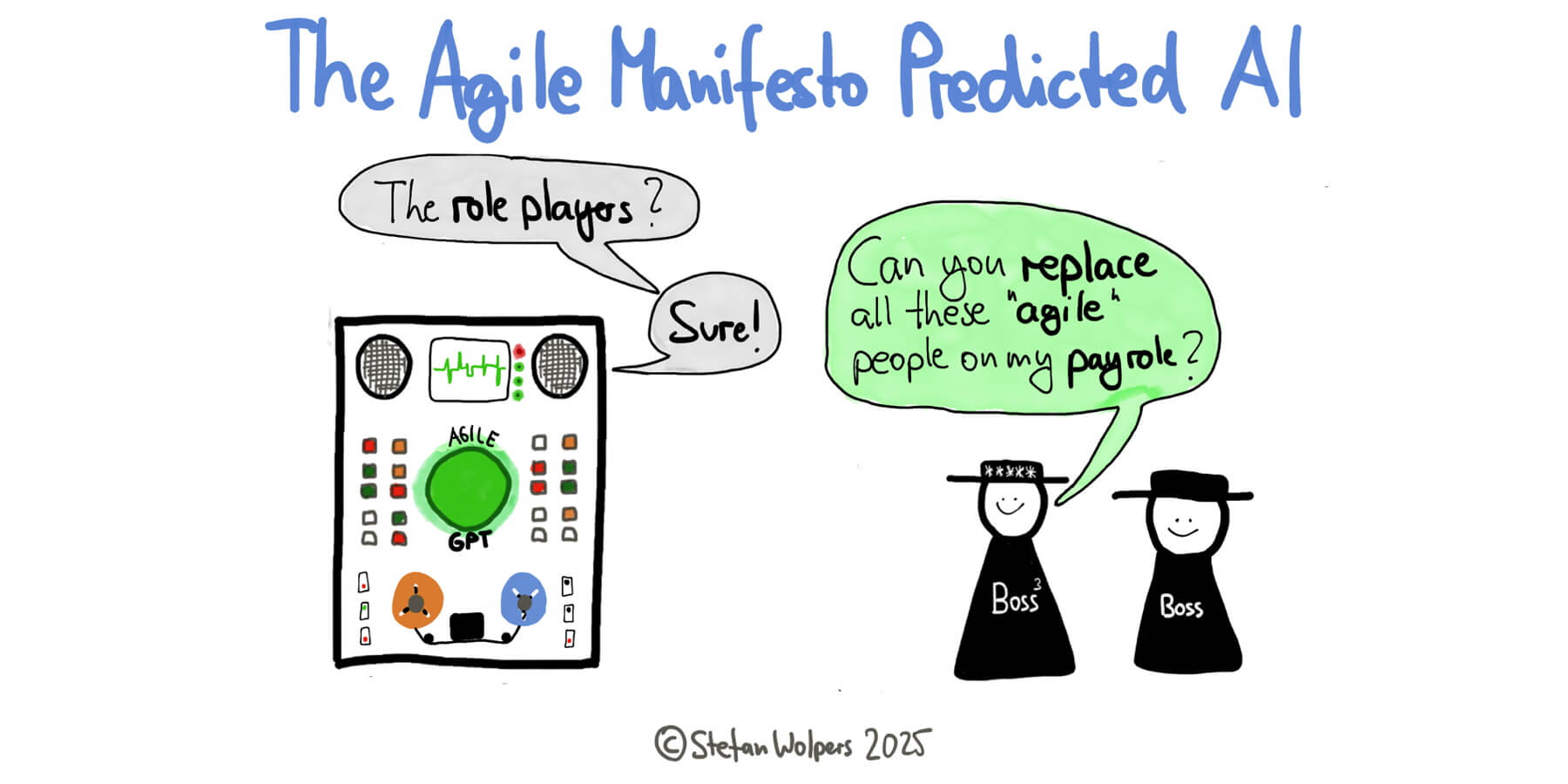
Here is what both camps miss: The biggest threat is not that AI replaces agile practitioners. It is AI that reveals what many organizations have suspected. They never needed Agile practitioners. They needed someone to manage Jira.
If your value proposition is running ceremonies, I deliberately do not refer to them as “events,” maintaining Product Backlogs, and generating burndown charts, AI reveals you were doing work the organization could have automated a decade ago. The separation is between practitioners who do real Agile work and those who perform Agile theater. AI is an expertise detector.
Agile AI Manifesto: AI Cannot Read the Room (And That’s Your Moat)
AI can analyze support tickets and identify the top five pain points. It cannot read the room during a tense stakeholder meeting and knows when to push versus when to back off, as it lacks empathy and an understanding of the current company’s politics and personal agendas of stakeholders. It cannot build psychological safety that allows teams to admit they do not understand the architecture. It cannot navigate organizational resistance by understanding which stakeholders need data, who needs stories, and who needs political cover.
These capabilities (reading context, building trust, facilitating difficult conversations, navigating politics) are your moat. AI makes this separation absolute. A mediocre practitioner armed with AI remains mediocre, now producing mediocre outputs faster. An expert practitioner armed with AI becomes significantly more effective.
Why “Good Enough” Agile Just Died
An experienced Product Owner using AI can now test ten positioning hypotheses in the time previously required for one or two. A skilled Scrum Master can analyze team dynamics across six Retrospectives to identify systemic impediments that manual review would probably miss.
The era of “good enough Agile” is coming to an end because “good enough” practitioners cannot fully leverage what AI offers. Organizations that recognize the value of this effect invest in structured AI capability development for expert practitioners. Expertise plus AI creates a competitive advantage. AI without expertise creates expensive noise. This reality drove overwhelming enrollment in my October cohort, with a waiting list comprising 6,000-plus peers.
What to Do Monday Morning
The strategic question, “Will AI amplify or replace me?”, matters less than the tactical one: “What am I doing this week to ensure AI is amplifying my capabilities?” To get your reflection going:
The Agile AI Manifesto for Scrum Masters:
Take your last three Retrospectives. Use AI to analyze transcripts or notes and identify patterns that you might have missed manually. Then design one facilitation experiment based on that insight. The value is not the AI analysis. It is whether you can translate it into better facilitation. If you cannot, the AI reveals a gap in your expertise.
For Product Owners and Product Managers:
Take your last 100 customer support tickets or user feedback items. Use AI to synthesize patterns and identify the top five latent needs. Then spend one hour with your Developers discussing whether these needs align with your product strategy and how you would validate them. If you cannot lead that conversation effectively, the AI reveals you do not understand product discovery fundamentals.
For Agile Coaches:
Take your current client engagement. Utilize AI to analyze available organizational data, including meeting patterns, communication flows, and decision-making dynamics. Identify one systemic impediment you had not previously surfaced. Then design one intervention to address it. If you cannot design that intervention, the AI reveals you are delivering playbooks, not coaching.
The Agile Manifesto predicted this moment by understanding something timeless: technology serves people, not the other way around. The practitioners who thrive will be those who make that principle operational this week, not eventually.
The question each practitioner should ask is simple: Will I dismiss this as hype, embrace it as replacement, or learn to wield it as amplification?
Those preparing for this shift are investing in structured capability development, which we will explore starting October 13.
Agile AI Manifesto Conclusion
The Agile Manifesto remains relevant not despite AI, but because of it. The Manifesto authors got something right: Principles built on human needs survive technology changes. AI amplifies what you bring: Bring expertise, judgment, and the ability to handle human complexity; AI makes you more effective. Bring only mechanical competence, and AI shows you were always replaceable.
Your choice. Choose wisely.
References
[1] Dell’Acqua, F., Ayoubi, C., Lifshitz-Assaf, H., Sadun, R., Mollick, E. R., Mollick, L., Han, Y., Goldman, J., Nair, H., Taub, S., & Lakhani, K. R. (2025). “The Cybernetic Teammate: A Field Experiment on Generative AI Reshaping Teamwork and Expertise.” Harvard Business School Working Paper No. 25-043. Available at: https://papers.ssrn.com/sol3/papers.cfm?abstract_id=5188231
[2] Harvard Business School Digital Data Design Institute. (2025). “The Cybernetic Teammate: How AI is Reshaping Collaboration and Expertise in the Workplace.” Available at: https://d3.harvard.edu/the-cybernetic-teammate-how-ai-is-reshaping-collaboration-and-expertise-in-the-workplace/
[3] Mollick, E. (2025, March 22). “The Cybernetic Teammate.” One Useful Thing. Available at: https://www.oneusefulthing.org/p/the-cybernetic-teammate
Agile AI Manifesto — Related Posts
AI Risks: Why Product Professionals Are Sleepwalking Into Strategic Irrelevance
AI Transformation Déjà Vu: Why Today’s Failures Look Uncannily Like Yesterday’s “Agile Transformations”
The Statistical AI Parrot in Your Sprint: Why AI Won’t Replace Your Agile Team (and Why Ignoring It Is a Mistake)
Ethical AI in Agile: Four Guardrails Every Scrum Master Needs to Establish Now
Generative AI in Agile: A Strategic Career Decision
Contextual AI Integration for Agile Product Teams

Stefan Wolpers: The Scrum Anti-Patterns Guide (Amazon advertisement.)
Scrum Training Classes, Workshops, and Events
Learn more about the Agile AI Manifesto with our AI and Scrum training classes, workshops, and events. You can secure your seat directly by following the corresponding link in the table below:
See all upcoming classes here.

You can book your seat for the training directly by following the corresponding links to the ticket shop. If your organization’s procurement process requires a different purchasing approach, please contact Berlin Product People GmbH directly.
✋ Do Not Miss Out and Learn more about the Agile AI Manifesto — Join the 20,000-plus Strong ‘Hands-on Agile’ Slack Community
I invite you to join the “Hands-on Agile” Slack Community and enjoy the benefits of a fast-growing, vibrant community of agile practitioners from around the world.

If you would like to join all you have to do now is provide your credentials via this Google form, and I will sign you up. By the way, it’s free.