TL; DR: Ethical AI or Risk?
Without ethical AI, Product Owners and Product Managers (PO/PMs) face a dilemma: balancing AI’s potential with its risks in product discovery and delivery. Unchecked AI can introduce bias, compromise data, and erode empathy.
To navigate this, implement four guardrails: ensuring data privacy, preserving human value, validating AI outputs, and transparently attributing AI’s role. This approach transforms PO/PMs into ethical AI leaders, blending AI’s power with indispensable human judgment and empathy.
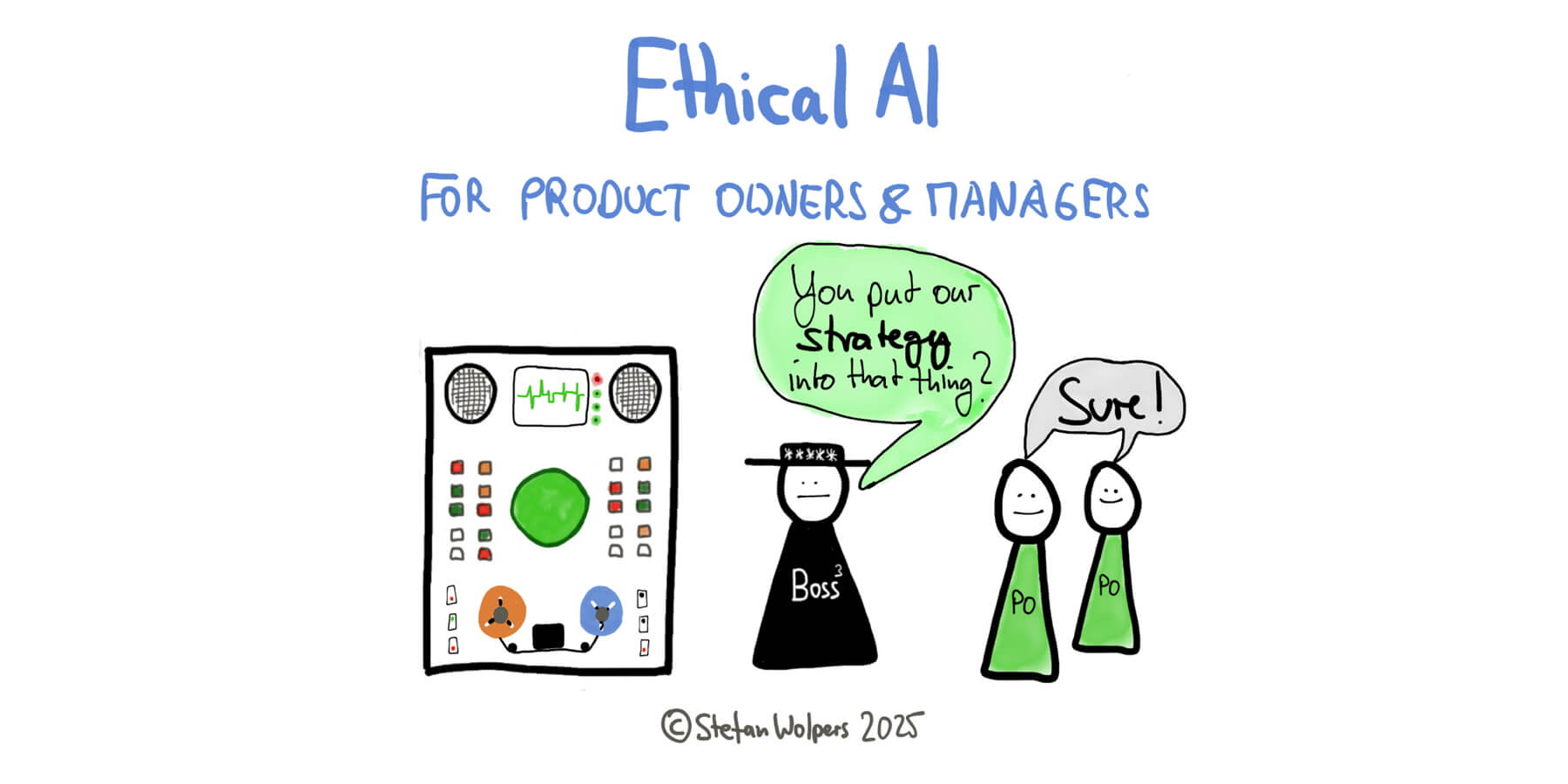
Shall I notify you about articles like this one? Awesome! You can sign up here for the ‘Food for Agile Thought’ newsletter and join 40,000-plus subscribers.
The AI-Enhanced Advanced Product Backlog Management Course Version 2—July 15, 2025
While many Product Owners spend sizable chunks of their time defending Product Backlog decisions, top-performing teams use systematic alignment processes to turn stakeholders into allies and backlogs into strategic assets.
This intensive course delivers the exact frameworks and AI-enhanced workflows that save successful Product Owners 15-20 hours weekly while improving stakeholder trust.
What’s Included:
- ✅ Self-paced video modules with practical exercises
- ✅ Launch week live Q&A sessions with Stefan
- ✅ Custom GPTs for Product Owner workflows
- ✅ Complete anti-patterns diagnostic toolkit
- ✅ Community access
- ✅ Lifetime access to all course updates and materials
- ✅ Certificate of completion.

Please note: The course will only be available for sign-up until July 22, 2025!
Join the Launch of the AI-Enhanced Version 2 on July 15: Learn How to Master the Most Important Artifact for any Successful Agile Practitioner!
Ethical AI Navigates Risks with Guardrails
As guardians of a product’s value and vision, Product Owners and Product Managers (PO/PMs) stand at a pivotal intersection of innovation and responsibility. The rise of Generative AI presents a powerful toolkit to analyze data, draft user stories, and accelerate the product lifecycle. However, this power introduces a new class of ethical challenges directly into Product Backlog Management. For product leaders, navigating this landscape requires more than just technical adoption; it demands a framework of ethical guardrails to lead teams with confidence and integrity, ensuring that AI is a responsible co-pilot, not an untrusted autocrat.
The Product Manager’s AI Dilemma
The core of the PO/PM’s AI dilemma lies in balancing its immense potential against the critical risks it introduces. While AI can analyze user feedback at an unprecedented scale, its output can be flawed, biased, or misaligned, potentially steering a product in the wrong direction. Peers and stakeholders raise valid concerns:
- How can one evaluate the quality and correctness of AI-generated results?
- How can confidential stakeholder information be used without breaching trust?
- And fundamentally, what becomes of the product manager’s strategic role in an age of automation?
The risk of unchecked AI use strikes at the heart of the PO/PM function. Key dangers include:
- Bias in User Stories and Personas: AI models trained on historical data can perpetuate and amplify existing biases. This can lead to user stories or personas that misrepresent or exclude key user segments, resulting in a product that fails to serve its entire audience.
- Compromising Stakeholder and Customer Data: The simple act of pasting raw notes from a stakeholder interview or customer feedback into a public AI tool can constitute a severe breach of confidentiality, violating trust and potentially running afoul of data protection regulations.
- Erosion of Empathy and Domain Expertise: This is perhaps the most critical risk. A PO/PM’s value is deeply rooted in their empathetic understanding of a user’s pain points and the nuanced needs of stakeholders, often gleaned through direct conversation. Over-reliance on AI summaries can weaken this essential “product empathy” and erode the domain expertise that fuels true product insight.
- Losing Stakeholder Trust: Presenting AI-generated roadmaps or user stories as perfectly formed artifacts is a recipe for damaged credibility. When inevitable flaws or misinterpretations are discovered, stakeholders’ trust in the product leader’s judgment can be significantly undermined.
- The ‘Feature Factory’ Trap: Using AI to generate a ‘perfect’ Product Backlog can short-circuit the essential, sometimes messy, collaborative discovery and alignment process. It risks shifting the team’s focus from a shared understanding of problems to the rote execution of AI-generated features, turning a dynamic team into a feature factory.
Cannot see the form? Please click here.
A Pragmatic Solution to Introduce Ethical AI: The Four Guardrails
To manage these risks, product leaders can champion a framework of four pragmatic guardrails. These are not heavy bureaucratic processes but rather shared team agreements designed to ensure AI is used safely and effectively, protecting customers, stakeholders, and the product itself:
1. Data Privacy & Compliance
As the product and customer information steward, the PO/PM must lead the process of protecting sensitive data. The Product Backlog often contains confidential customer feedback, competitive analysis, and strategic plans that cannot be exposed. This guardrail requires establishing clear protocols for what data can be shared with AI tools. A practical first step is to lead the team in a data classification exercise, categorizing information as Public, Internal, or Restricted. Any data classified for internal use, such as direct customer quotes, must be anonymized before being used in an AI prompt. Finally, the PO/PM must verify that all AI use complies with relevant data protection regulations like GDPR or HIPAA that govern the product’s domain.
2. Human Value Preservation
AI is proficient at generating text but possesses no real-world experience, empathy, or strategic insight. This guardrail involves proactively defining the unique, high-value work that AI can assist but never replace. Product leaders should clearly delineate between AI-optimal tasks, creating first drafts of technical user stories, summarizing feedback themes, or checking for consistency across Product Backlog items and PO/PM-essential areas. These human-centric responsibilities include building genuine empathy through stakeholder interviews, making difficult strategic prioritization trade-offs, negotiating scope, resolving conflicting stakeholder needs, and communicating the product vision. By modeling this partnership and using AI as an assistant to prepare for strategic work, the PO/PM reinforces that their core value lies in strategy, relationships, and empathy.
3. Output Validation
AI output can be subtly biased, factually incorrect, or misaligned with the product vision. As the ultimate owner of the Product Backlog, the PO/PM is accountable for validating all AI-generated content. This guardrail establishes a “human-in-the-loop” protocol where no AI-generated item is accepted without rigorous verification. A powerful practice is to enforce a “triangulation protocol,” where AI output is cross-checked against primary sources:
- Does an AI-generated persona truly reflect user interview findings?
- Does an AI-written user story accurately capture a stakeholder’s request?
- Does a suggested feature align with current strategic goals?
The product leader is the final checkpoint, ensuring AI serves the product strategy, not the other way around.
4. Transparent Attribution
A product leader’s credibility is paramount. This guardrail focuses on maintaining stakeholder trust through transparency. It is crucial to be open about AI’s role in the process. Internally, a simple “AI Contribution Registry” can document where AI was used to refine key artifacts. When presenting materials to stakeholders, a clarifying note like “Initial analysis conducted with AI assistance and validated by the product team” frames AI as a tool being commanded, not a source being blindly followed. This proactive transparency manages expectations, prevents stakeholders from developing a false sense of certainty in AI-generated plans, and reinforces their trust in the product leader’s strategic judgment.
Ethical AI — A Call for Critical Reflection
Before automating any Product Backlog management task, a product leader should pause for critical reflection. Convenience is not always the highest value. Could generating a ‘perfect’ Product Backlog item with AI prevent the team from having the messy but necessary discussions that lead to true shared understanding? Is AI being used to avoid a difficult conversation with a stakeholder, thereby eroding personal influence and empathy? Does this use of AI move the team closer to collaborative discovery or toward a ‘feature factory’ executing a pre-cooked plan? The goal is to balance AI’s convenience with the PO/PM’s fundamental need to foster discussion, iteration, and genuine team alignment.
Conclusion: From Manager to Ethical AI Leader
Adopting these guardrails is not merely about mitigating risk; it is about enhancing effectiveness and future-proofing the Product Owner and Product Manager role. By automating routine tasks, product leaders can focus more on high-value strategic work, user research, and stakeholder relationships. They can make better, faster decisions by combining AI-powered analysis with human judgment. The ethical use of AI is no longer a peripheral topic; it is central to the mission of delivering value responsibly. By implementing a clear action plan, championing data classification, defining a human-AI partnership, updating the Definition of Done to include validation, and adding AI guidelines to the team charter, a PO/PM can take immediate steps to lead their team into a new era of responsible innovation. In doing so, they transition from being a manager of products to a pioneering leader who blends AI’s analytical power with irreplaceable human empathy and vision.
Ethical AI — Related Posts
Contextual AI Integration for Agile Product Teams
Is Vibe Coding Agile or Merely a Hype?
The Agile Prompt Engineering Framework
Generative AI in Agile: A Strategic Career Decision
Why Leaders Believe the Product Operating Model Will Succeed Where Agile Initiatives Failed
Stefan Wolpers: The Scrum Anti-Patterns Guide (Amazon advertisement.)
Scrum Training Classes, Workshops, and Events
Learn more about Hands-on Agile 2025 with our Scrum training classes, workshops, and events. You can secure your seat directly by following the corresponding link in the table below:
See all upcoming classes here.

You can book your seat for the training directly by following the corresponding links to the ticket shop. If the procurement process of your organization requires a different purchasing process, please contact Berlin Product People GmbH directly.
✋ Do Not Miss Out and Learn more about Ethical AI — Join the 20,000-plus Strong ‘Hands-on Agile’ Slack Community
I invite you to join the “Hands-on Agile” Slack Community and enjoy the benefits of a fast-growing, vibrant community of agile practitioners from around the world.

If you would like to join all you have to do now is provide your credentials via this Google form, and I will sign you up. By the way, it’s free.