TL; DR: The Immunity Response and How the Principles Spread Anyway
Organizations resist change through immune responses: encapsulation, assimilation, exhaustion, redefinition, and expulsion. But immune systems attack what they recognize. Hence, if you are in the business of change and expect push-back, stop announcing transformations. Instead, to overcome the immunity response, start solving problems: The principles spread through practice, through demonstrations of value, not by proclamation.
This article is Part 3 of a three-part series. In Part 1, Agile Is Dead, Long Live Agility, we saw how the Agile brand became toxic while the principles spread faster than ever under different names. In Part 2, The Reformation That Became the Church, we traced how every disruptive movement hardens into the orthodoxy it opposed.
This final part answers the question we left open: Can you practice the principles without the apparatus? Yes. But only if you understand why organizations reject change and how to stop triggering that rejection.
Shall I notify you about articles like this one? Awesome! You can sign up here for the ‘Food for Agile Thought’ newsletter and join 35,000-plus subscribers.
Your Transformation Rarely Fails Because of Bad Actors
Your transformation didn’t fail because of bad actors. It failed because organizations are organisms, and organisms have immune systems.
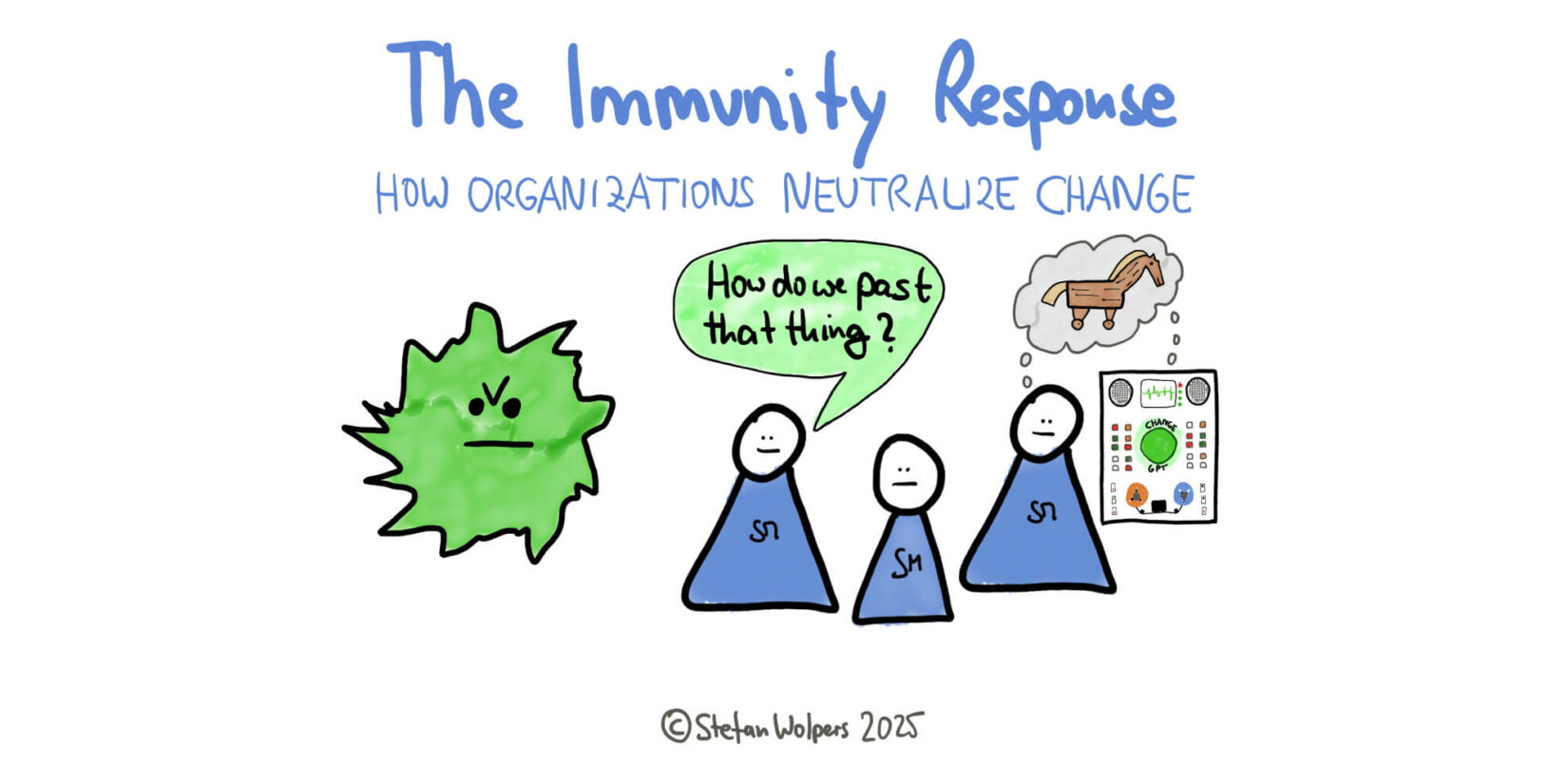
The immune system’s job is to identify foreign matter and neutralize it before it disrupts homeostasis, the body’s automatic process of maintaining a stable, balanced internal environment despite external changes. Your “Agile transformation” was a foreign matter, and the organism did its job.
But the immune system has a blind spot. It attacks what it recognizes: labels, frameworks, capital-letter initiatives. It doesn’t attack someone asking, “What’s stopping us from shipping this week?”
Understanding the immune system doesn’t mean surrender. It means you can stop triggering the immunity response. Think of it as your Trojan Horse.
Cannot see the form?
Please click here.
The Five Antibodies
If you’ve worked inside an organization attempting change, you’ve seen at least three of these:
- Encapsulation: Surround the foreign body so it can’t spread. The “Agile Center of Excellence” isolates practices within a single department. Pilot teams succeed in quarantine. The infection never reaches the host.
- Assimilation: Absorb the foreign body until it’s indistinguishable from self: “We’re doing Agile our way.” Daily Scrums become status meetings. Retrospectives become blame sessions. The vocabulary changes, titles change; the behavior doesn’t.
- Exhaustion: Agree to everything, fund nothing: “We fully support this initiative.” However, don’t provide budget, authority, or air cover. Wait for champions to burn out.
- Redefinition: Declare that the foreign body was already present: “We’ve always been agile.” Relabel existing practices, and claim transformation accomplished.
- Expulsion: Remove the carriers, like agile coaches. They churn out after 6-18 months anyway. Don’t fire them for cause; avoid renewing contracts. Then, new leadership arrives, brings their own consultants, and the cycle restarts.
Which immunity response is happening to you right now?
Why the Immune System Exists
These responses aren’t villainy; they are about survival and are deliberately designed to strengthen resilience.
Organizations that chased every trend ended up confused and directionless. The immune system protects stability. It remembers the last three “transformations” that disrupted everything and delivered nothing. It learned.
The problem isn’t that the immune system exists. The problem is that it can’t distinguish between threats and cures. The immune system recognizes threats by their markers: “Agile transformation” is a marker. “Scrum implementation” is a marker. These phrases activate the antibodies before you have accomplished anything.
But “let’s talk to a customer before we build the next feature” is not a marker. That sounds like common sense. The immune system doesn’t patrol common sense. And that’s your way in.
Evading Detection to Avoid the Immunity Response
Every failed transformation I’ve seen announced itself, with banners, steering committees, transformation offices, mugs, t-shirts, and caps. The organism saw it coming and mobilized accordingly.
On the other hand, every quiet success did the opposite: one team solving one problem, running one experiment, with no announcements. Just: “What if we tried it differently this Sprint?”
The strategy isn’t to overpower the immune system. You can’t. The strategy is to stop triggering it. Embrace the Greek approach, build a wooden horse, and leave it before the gate.
Which reminds me of a division of a large automotive supplier I worked with back in the late 2010s. The first attempt was textbook transformation theater: “Agile@XYZ”, a transformation office, external consultants, maturity assessments, and a launch event where the Senior VP running the division used the word “journey” eleven times.
The immune system deployed assimilation and exhaustion. Within six months, standups had become 45-minute status meetings. Retrospectives became blame sessions. And meeting the “Definition of Ready” quote defined by a Jira plug-in before Sprint Planning was more important than creating and delivering a meaningful Sprint Goal. By 2019, all the good people had moved on. It was dead, not cancelled, just gone.
Now, one product team, frustrated by 18 months of building the wrong thing, started showing working software to actual customers every two weeks. They didn’t call it anything. They just wanted to stop wasting effort and speed up value delivery, deliberately bypassing the sales and UX folks.
Other teams noticed and became curious. The product team shared what they did, in plain language: “We show customers what we built and ask if it’s useful.” Nobody called it Scrum. Nobody called it Agile. Just: “This is how we check if we’re building the right thing.”
Same organization, same constraints, same middle managers, just one difference: One formal approach triggered every antibody, the other triggered none.
The Carriers Who Stay
I have watched good practitioners leave after their transformation was neutralized. That is unfortunate, but not unexpected; some organisms won’t accept the transplant. If all five antibodies are deployed and leadership has no appetite for change, you’re not in a transformation. You’re in a theater performance, and leaving isn’t defeat; it’s honesty. (I have fired myself several times because of that.)
But some of us stay, not out of stubbornness. Because we have learned that the principles don’t need the transformation to succeed, they need carriers, they need people who practice them quietly, demonstrate results, and let curiosity do the recruiting.
In Part 2, I asked whether you can refuse to become a priest while working inside the church, and this is how it works: by remembering that the principles existed before the apparatus and will likely outlast it.
Conclusion: The Principles Will Prevail
The Manifesto’s authors didn’t write it so we would have something to implement. They wrote it because they had found ways of working that solved problems better: four values and twelve principles, all on one page.
Everything that came after (the frameworks, the certifications, the transformation industry) was an attempt to package those ideas. Some of it helped. Some of it became what the Manifesto was reacting against. The reformation became a church.
But the principles don’t need the church to spread. They spread because they work.
We are not paid to practice Scrum, Kanban, SAFe, or any other framework. We are not paid to “be Agile” or to “transform” anything. We are paid to solve our customers’ problems within given constraints while contributing to our organization’s sustainability.
As long as we deliver that value in an ethical, legal, sustainable, and financially viable way, nobody cares what we call it. And rightfully so. The principles will prevail because what works eventually wins.
Your job was never to “transform” the organization. It was to help it solve problems. If the front door is guarded, use the side door. If the side door is locked, open a window. The principles don’t care how they get in.
They only care that we practiced them.
Which antibody is your organization deploying right now? And what’s one practice you could introduce this week without triggering it? I’m curious.
The Immunity Response — Related Posts
The Reformation That Became the Church
Agile Is Dead, Long Live Agility
From Mechanical Ceremonies to Agile Conversations
Why Agility Matters (And How to Break the Cycle When It Doesn’t)
AI Transformation Déjà Vu: Why Today’s Failures Look Uncannily Like Yesterday’s “Agile Transformations”
Why Leaders Believe the Product Operating Model Will Succeed Where Agile Initiatives Failed
Agile Failure Patterns in Organizations 2.0

Stefan Wolpers: The Scrum Anti-Patterns Guide (Amazon advertisement.)
Scrum Training Classes, Workshops, and Events
Learn more about the Agile AI Manifesto with our AI and Scrum training classes, workshops, and events. You can secure your seat directly by following the corresponding link in the table below:
See all upcoming classes here.

You can book your seat for the training directly by following the corresponding links to the ticket shop. If your organization’s procurement process requires a different purchasing approach, please contact Berlin Product People GmbH directly.
✋ Do Not Miss Out and Learn More about the Immunity Response — Join the 20,000-plus Strong ‘Hands-on Agile’ Slack Community
I invite you to join the “Hands-on Agile” Slack Community and enjoy the benefits of a fast-growing, vibrant community of agile practitioners from around the world.

If you would like to join all you have to do now is provide your credentials via this Google form, and I will sign you up. By the way, it’s free.