TL; DR: The Costs of an Oversized Product Backlog
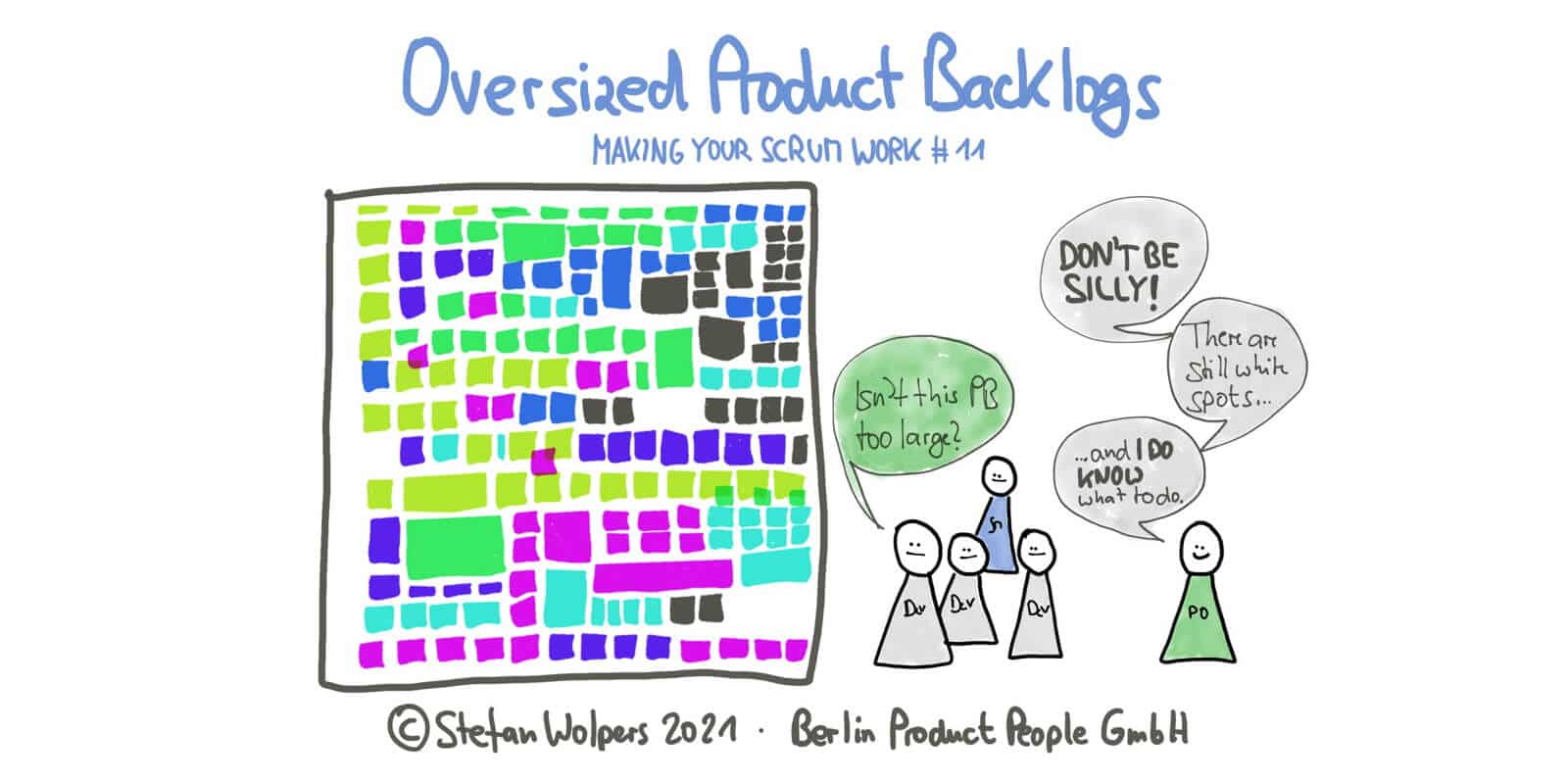
Some Product Owners believe that a comprehensive Product Backlog is the best way to accomplish the Product Goal and be fully transparent simultaneously—never let a possibly valuable idea slip away. However, a comprehensive backlog may quickly become an oversized Product Backlog with unintended side effects.
Learn more about an oversized Product Backlog’s negative impact on innovation, your Scrum team’s ability to create value, and your relationship with stakeholders.
Shall I notify you about articles like this one? Awesome! You can sign up here for the ‘Food for Agile Thought’ newsletter and join 47,000-plus subscribers.
The most popular discussion on LinkedIn last week was: What do you think is the best fit for Project Managers in Agile?
Join Stefan in one of his upcoming Professional Scrum training classes!
Get notified when the Scrum Anti-Patterns Guide book is available!
The Costly Side-Effects of an Oversized Product Backlog
Some Product Owners believe that maintaining an extensive Product Backlog is an optimal strategy to achieve the Product Goal and uphold complete transparency—ensuring that no potential valuable idea goes unnoticed. However, building a comprehensive list of all imaginable work items in advance is not just a waste of a Scrum Team’s time; moreover, an oversized Product Backlog is a costly mistake in the long run.
Here are eight critical side effects of this Product Backlog anti-pattern:
- Encourages Waste: An oversized Product Backlog fosters waste by investing time in items that may never be developed due to the continuous discovery of more valuable tasks. It’s a clear violation of Agile Manifesto principles; particularly, simplicity—the art of maximizing the work not done—is essential.
- Sunk Cost Fallacy Risk: A large Product Backlog can lead to the sunk cost fallacy. Teams may continue to refine and prioritize items because they’ve already invested time into them rather than because they add significant value. This behavior contradicts the Agile Manifesto’s principle of continuous improvement and adaptation.
- Leads to Analysis Paralysis: A huge Product Backlog can cause what’s known as analysis paralysis, where the sheer volume of items becomes overwhelming, leading to indecision and delay. The team might spend excessive time evaluating, prioritizing, and re-prioritizing items, which detracts from their capacity to focus on actual product development. This excess of choices often slows down decision-making processes, making it difficult for the team to determine where to start or what to focus on next. Ultimately, this slows down the entire project, diverting energy away from creating value for the customer and towards managing the Product Backlog itself.
- Damages Stakeholder Engagement: A bloated Product Backlog presents a significant challenge regarding effective communication. The vast number of items can make it difficult for stakeholders to comprehend the plan, the progress, and the order of priority, leading to potential misalignment of expectations. Stakeholders may struggle to find their specific interests within the large list, confusing them and potentially causing a feeling of detachment.
- Crowding Out Effect: A comprehensive, oversized Product Backlog may inadvertently discourage stakeholders and team members from contributing their ideas and insights. The backlog’s perceived completeness might give the impression that there’s no room or need for additional input, potentially missing valuable ideas and insights.
- Inhibits Innovation: A huge Product Backlog can unintentionally stifle the creative energy within the Scrum Team. The lengthy list of tasks can create a culture of ‘checking off the boxes’ where the team focuses more on completing the tasks rather than exploring and innovating. The team may feel constrained, perceiving that there’s no room for new ideas, which can limit their creative problem-solving skills and deter them from finding innovative solutions. This mindset contradicts the Scrum value of ‘openness’ and the Agile principle of harnessing change for the customer’s competitive advantage.
- False Sense of Security: An exhaustive Product Backlog may provide a false sense of security, an illusion of control. It might seem like the Scrum team identified all the necessary work, reducing the perceived need for discovery and learning. This misalignment with the Scrum Guide, which advocates for iterative learning and discovery, can be harmful.
- Encourages Early Optimization: A bulging Product Backlog can lead to premature optimization, as the team may feel compelled to design systems or workflows that anticipate the completion of future backlog items, resulting in unnecessary complexity, contributing to waste if these tasks later change or get deprioritized. This approach conflicts with the Agile principle of simplicity—the art of maximizing the amount of work not done—and the Scrum value of focus, as it encourages effort toward uncertain future needs rather than the most valuable present ones.
Cannot see the form? Please click here.
How to Best Counter the Effects of an Oversized Product Backlog
Fortunately, many ways exist to avoid creating an oversized Product Backlog right from the start. Best of all, it is up to the Scrum team to put them to good use. Here are eight tactics to get started:
- Embrace Simplicity: Stick to the Agile Manifesto’s principle of simplicity, which entails maximizing the work not done. Focus on the most valuable items to deliver the highest customer and business value.
- Limit WIP (Work In Progress): Limit the number of items in the Product Backlog at any time. The WiP limit can prevent overloading and encourage the team to complete items before taking on new ones.
- Regularly Refine the Backlog: Keep the Product Backlog manageable by conducting regular refinement sessions to ensure that items are still relevant, valuable, and properly prioritized.
- Just-in-Time Refinement: Avoid over-refining items that aren’t imminent for development. The further an item is from being selected for a Sprint, the less detail it should have. The Scrum team adds details in refinement sessions just in time.
- Prioritize and Deprioritize: Embrace the fact that not all Product Backlog backlog items will be implemented. Regularly prioritize and, if necessary, deprioritize or delete items from the backlog that no longer align with the Product Goal.
- Empower Teams: Encourage self-organization within the Scrum team. Empower them to propose and negotiate items in the Product Backlog, enhancing their sense of ownership and commitment. Great Developers always challenge their Product Owners!
- Promote Open Dialogue: Foster a culture of open dialogue and collaboration between the Scrum team, stakeholders, and Product Owner. Encourage all to contribute ideas and challenge existing ones, avoiding the ‘crowding out’ effect.
- Continuous Learning and Adaptation: Adhere to Scrum’s empirical process of “transparency, inspection, and adaptation.” Learn from every Sprint, adapt the Product Backlog based on insights, for example, from the Sprint Review, and be open to changes.
Conclusion
The Product Backlog is a critical tool in product development with Scrum. Its effectiveness is tied to simplicity, limiting work in progress, regular refinement, just-in-time detailing, prioritization, team empowerment, open dialogue, and continuous learning. All these principles work together to keep the Product Backlog focused, actionable, and aligned with the Product Goal, thus enhancing transparency and fostering a culture of collaboration and continuous improvement.
How are you countering an emerging oversized Product Backlog? Please share with us in the comments.
The Expensive Folly of the Oversized Product Backlog — Related Articles
27 Product Backlog and Refinement Anti-Patterns
Product Backlog Refinement: 14 First Principles
A Forensic Product Backlog Analysis — Making Your Scrum Work
Product Owner Anti-Patterns — 33 Ways to Improve as a PO
Download the Scrum Anti-Patterns Guide for free.
Scrum Training Classes, Workshops, and Events
Learn more about avoiding an oversized Product Backlog with our Scrum training classes, workshops, and events. You can secure your seat directly by following the corresponding link in the table below:
| Date |
Class and Language |
City |
Price |
| September 26-29, 2023 |
GUARANTEED: Professional Scrum Product Owner Training (PSPO I; German; Live Virtual Class) |
Live Virtual Class |
€1.189 incl. 19% VAT |
| October 4, 2023 |
GUARANTEED: Professional Scrum Facilitation Skills Training (PSFS; English; Live Virtual Class) |
Live Virtual Class |
€749 incl. 19% VAT |
| October 10, 2023 |
GUARANTEED: Hands-on Agile #54: Product Backlog Management Traps — David Pereira (English; Live Virtual Meetup) |
Live Virtual Class |
FREE |
| October 30-31, 2023 |
Professional Scrum Master (Advanced) Training (PSM II; German; Live Virtual Class) |
Live Virtual Class |
€1.189 incl. 19% VAT |
| November 1-2, 2023 |
Professional Scrum Master Training (PSM I; German; Live Virtual Class) |
Live Virtual Class |
€1.189 incl. 19% VAT |
| November 8, 2023 |
GUARANTEED: Hands-on Agile #55: Designing Agile Ecosystems with Org Topologies™ w/ Alexey Krivitsky and Roland Flemm (English; Live Virtual Meetup) |
Live Virtual Class |
FREE |
| November 21-24, 2023 |
Professional Scrum Product Owner Training (PSPO I; German; Live Virtual Class) |
Live Virtual Class |
€1.189 incl. 19% VAT |
| November 28, 2023 |
GUARANTEED: Professional Scrum Facilitation Skills Training (PSFS; English; Live Virtual Class) |
Live Virtual Class |
€749 incl. 19% VAT |
| December 11-12, 2023 |
Professional Scrum Master Training (PSM I; German; Live Virtual Class) |
Live Virtual Class |
€1.189 incl. 19% VAT |
| December 13-14, 2023 |
Professional Scrum Product Owner Training (PSPO I; German; Live Virtual Class) |
Live Virtual Class |
€1.189 incl. 19% VAT |
| December 18-19, 2023 |
Professional Scrum Master (Advanced) Training (PSM II; English; Live Virtual Class) |
Live Virtual Class |
€1.189 incl. 19% VAT |
See all upcoming classes here.

You can book your seat for the training directly by following the corresponding links to the ticket shop. If the procurement process of your organization requires a different purchasing process, please contact Berlin Product People GmbH directly.
✋ Do Not Miss Out and Learn more about the Effects of an Oversized Product Backlog — Join the 12,000-plus Strong ‘Hands-on Agile’ Slack Community
I invite you to join the “Hands-on Agile” Slack Community and enjoy the benefits of a fast-growing, vibrant community of agile practitioners from around the world.

If you like to join all you have to do now is provide your credentials via this Google form, and I will sign you up. By the way, it’s free.
Support your team’s efforts regarding avoiding an oversized Product Backlog by pointing to the free Scrum Anti-Patterns Guide: