TL; DR: Unfinished Action Items: How to Make Retrospectives Useful
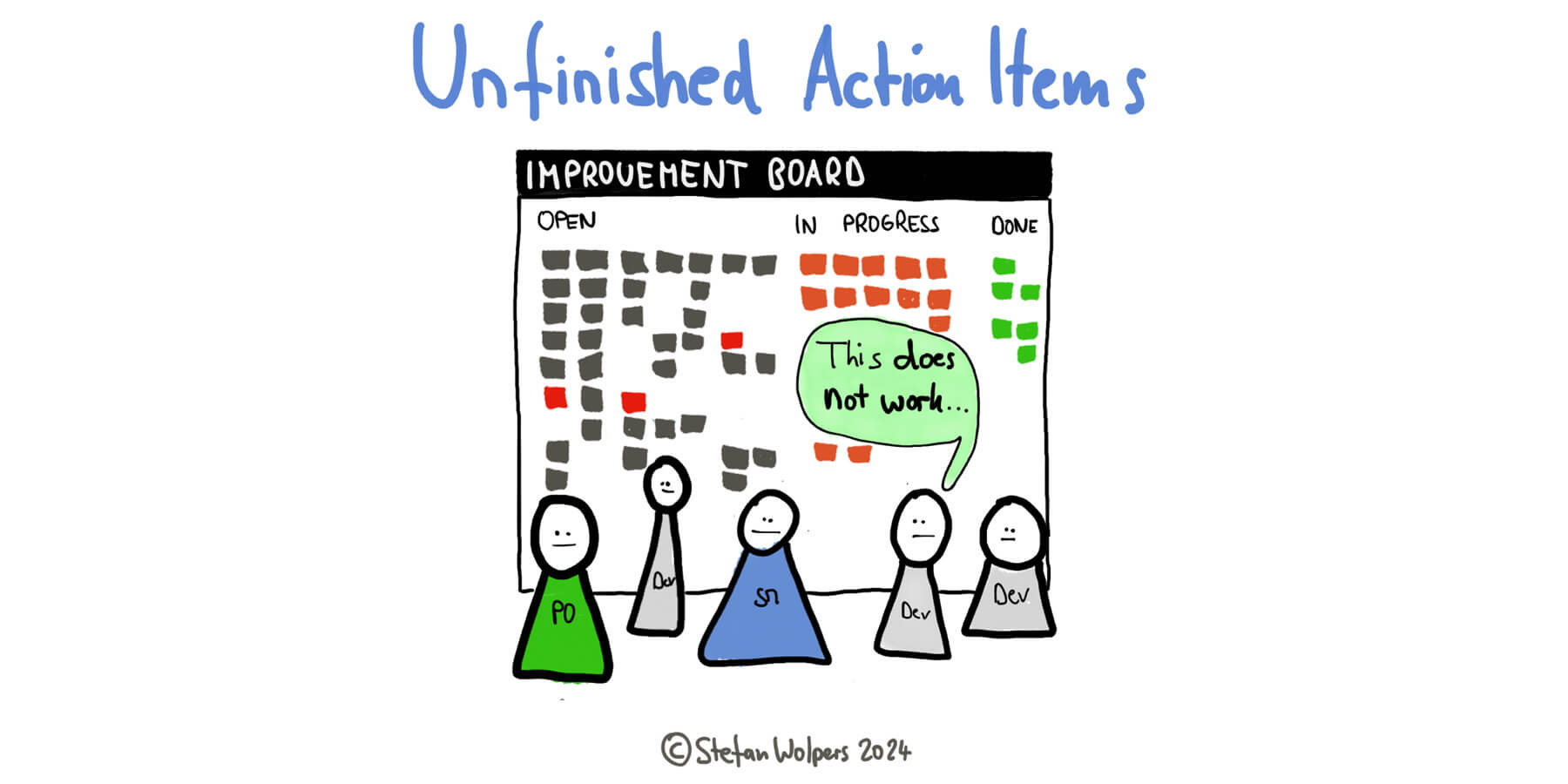
If your team consistently creates action items during Retrospectives but rarely completes them, you’re not alone. Unfinished action items are a major productivity killer and lead to stalled progress. This article highlights five actionable practices to ensure Retrospective tasks get done, including limiting action items in progress, assigning clear ownership, and adding a reviewing progress in every Retrospective.
The key to real improvement isn’t in creating long lists—it’s in following through. By treating Retrospective action items with the same importance as other Sprint tasks, your team can finally break the cycle of unfinished improvements and see real, beneficial change, individually and at the team level.
Join 400-plus Peers for the Free Hands-on Agile 2025 from February 4-6, 2025, and Talk about Agile Primitives!

HoA2025’s topic is: From Concept-Based to Context-Based Agility.
Shall I notify you about articles like this one? Awesome! You can sign up here for the ‘Food for Agile Thought’ newsletter and join 42,000-plus subscribers.
Join Stefan in one of his upcoming Professional Scrum training classes!
The Problem with Unfinished Action Items
How often have you left a Retrospective feeling like you’ve cracked the code, only to realize two Sprints later that nothing has changed? We’ve all been there. Teams are great at creating action items, but things tend to fall apart when it comes to following through. It’s not enough to just make lists of improvements—we need to actually implement them.
One of Scrum’s first principles is continuous improvement, derived from Lean’s Kaizen philosophy. Kaizen focuses on small, incremental changes that compound, driving long-term progress. Scrum incorporates this through Retrospectives, where teams identify areas for improvement after each Sprint. However, Kaizen only works when improvements are implemented. Unfinished action items break the cycle, leaving issues unresolved and stalling growth.
Unfinished action items are one of Scrum teams’ biggest productivity and improvement killers. Without follow-up, improvements remain theoretical. The accumulation of unfinished items leads to repeat issues and disengagement from the Retrospective process.
The True Purpose of a Retrospective: Why Action Items Are Still Essential
Many Scrum teams recognize the value of Retrospectives beyond just generating action items. They focus, for example, on team alignment or improving psychological safety, which are all vital elements of an effective team. However, without agreeing on improvements, these activities may prove superficial:
- Team Alignment ensures everyone is working cohesively toward the same goals. But alignment without concrete actions won’t result in real, tangible improvements.
- Psychological Safety promotes trust, but discussions without action can lead to complacency.
- Process Improvement discussions are valuable, but without actionable steps, those improvements will remain theoretical.
- Conflict Resolution helps smooth collaboration but should be followed by actions that prevent future issues.
- Continuous Learning drives reflection, but only becomes impactful when applied.
So, some teams believe these benefits alone are enough to call the Retrospective a success, often neglecting the crucial step of creating and following through on actionable improvements. While these five elements are critical, they are not enough on their own. Action items are the glue that binds these insights together and translates them into real, continuous improvement. Teams must avoid the pitfall of thinking that a Retrospective is complete without tangible, actionable steps.
Cannot see the form?
Please click here.
How to Turn Action Items into Completed Improvements
By following a few key strategies, you can double or even triple the effectiveness of your Retrospectives. It’s not just about identifying areas for improvement but ensuring those are followed through. The following steps will help your team turn Retrospective action items into actual, impactful results:
- Limit the Number of Action Items: Focus on 1–3 high-priority items per Retrospective. Too many action items overwhelm the team and lead to incomplete follow-through.
- Assign Clear Ownership and Dates: Each action item needs a specific owner and a “delivery date.” Without these, tasks fall through the cracks. Ensure items are concrete and measurable, such as “Sarah will set up a weekly sync with the marketing team by Friday.” (Think of “Directly Responsible Individuals.”)
- Review Previous Action Items at Every Retrospective: Start every Retrospective by reviewing the status of the last Sprint’s action items. This holds the team accountable and helps identify why certain items weren’t completed and where support from the team is needed. (Inspection and adaptation work here, too.)
- Track Action Items Publicly: Use a public board to track progress. Visibility drives accountability and ensures that action items don’t get forgotten.
- Make Action Items Part of Sprint Planning: Incorporate action items into Sprint Planning, ensuring they are treated with the same attention as other Sprint tasks, preventing them from being sidelined.
Food for Thought on Action Items
Here are some additional insights to help ensure that team members complete action items, leading to continuous improvement:
- SMART Goals for Action Items: Use SMART goals—Specific, Measurable, Achievable, Relevant, Time-bound—when defining Retrospective action items. Instead of saying “improve communication,” try “Set up a weekly check-in with the marketing team by Friday.” This ensures clarity and accountability. (Learn more about SMART and INVEST.)
- Continuous Monitoring During the Sprint: Don’t wait until the next Retrospective to check in on action items. Dedicate, for example, a portion of your Daily Scrum sessions to quickly review progress on action items if needed, ensuring they stay top-of-mind throughout the Sprint.
- Balance Between Process and Product Improvements: Ensure a balance between process improvements (like communication and collaboration) and product improvements (such as code quality and technical practices). Focusing too much on one over the other can lead to lopsided progress.
- Avoid Picking Only Low-Hanging Fruits: Real change results from tackling big issues that may require more than a Sprint or two to complete. Therefore, to reach your team’s full potential, avoid focusing solely on small improvements to keep your action item list short and tidy.
- Celebrate Wins: When action items are completed and result in improvements, recognize and celebrate these wins. This acknowledgment reinforces the value of the Retrospective and motivates the team to take future action items seriously.
- Be Mindful of Organizational Culture: Company culture has a significant impact on how action items are handled. If the organizational structure is too hierarchical or top-down, teams might feel powerless to implement change. Building a culture of autonomy and support for Scrum teams is, therefore, essential.
Conclusion: The Key to Continuous Improvement is Follow-Through
Unfinished action items undermine continuous improvement. While identifying areas for growth in a Retrospective is important, implementation is where progress happens. The Kaizen principle teaches us that meaningful change comes from small, consistent improvements, but only when the team ensures those improvements are realized.
To break the cycle of unfinished action items, focus on completing fewer, higher-impact actions. By following the five steps outlined here, your team can close the gap between planning and execution, and transform Retrospectives into a tool for real, measurable change. Continuous improvement isn’t just a principle—it’s a process, and your team holds the key to making it work.
Recommended Reading

Stefan Wolpers: The Scrum Anti-Patterns Guide (Affiliate advertisement at no cost to you.)
The Meta-Retrospective — Check Out the Free Miroverse Template
21 Sprint Retrospective Anti-Patterns Impeding Scrum Teams
Liberating Structures for Scrum (1): The Sprint Retrospective
Retrospective First Principles
UnSMART Improvements at Retrospectives — Making Your Scrum Work #18
Scrum Training Classes, Workshops, and Events for the Transformation to Agile Primitives
You can secure your seat for Scrum training classes, workshops, and meetups directly by following the corresponding link in the table below:
See all upcoming classes here.

You can book your seat for the training directly by following the corresponding links to the ticket shop. If the procurement process of your organization requires a different purchasing process, please contact Berlin Product People GmbH directly.
✋ Do Not Miss Out and Learn more about Avoiding Unfinished Action Items — Join the 20,000-plus Strong ‘Hands-on Agile’ Slack Community
I invite you to join the “Hands-on Agile” Slack Community and enjoy the benefits of a fast-growing, vibrant community of agile practitioners from around the world.

If you like to join all you have to do now is provide your credentials via this Google form, and I will sign you up. By the way, it’s free.
Support your team’s efforts to avoid Unfinished Action Items by pointing to the free Scrum Anti-Patterns Guide: