TL, DR: AI Interview Analysis
When you step into a new role as Scrum Master or agile coach for a team under pressure, you’re immediately confronted with a challenging reality: you need to understand the complex dynamics at play but have limited time to process all the available information. This article explores how AI interview analysis can be a powerful sensemaking tool for agile practitioners who need to synthesize unstructured qualitative data quickly, particularly when joining a team mid-crisis.
Shall I notify you about articles like this one? Awesome! You can sign up here for the ‘Food for Agile Thought’ newsletter and join 42,000-plus subscribers.
The AI-Enhanced Advanced Product Backlog Management Course Version 2—June 23, 2025
Are you facing problems aligning vision, stakeholders, your team, and delivering real value?
Is your contribution as a product leader questioned?
Then, prepare to transform your career with my AI-enhanced, comprehensive, self-paced online class. Dive deep into professional Product Backlog management techniques supported by videos, exercises, and the latest AI models.

Please note: The course will only be available for sign-up until June 30, 2025!
Join the Launch of the AI-Enhanced Version 2 on June 23: Learn How to Master the Most Important Artifact for any Successful Agile Practitioner!
The Challenge I: Information Overload with Limited Time
Imagine you’re the new Scrum Master in a startup for a team under severe pressure:
- Series B funding on the line if the next release fails,
- Technical debt accumulating,
- Burnout signals flashing red.
On your desk are transcripts from personal interviews with your new teammates, business stakeholders, and leadership team members.
You need to understand what’s happening—fast. But who has time to manually analyze hours of conversations when there are fires to put out? On the other hand, is becoming busy and picking low-hanging collaboration fruits the best choice?
The scenario isn’t hypothetical; I have been there plenty of times with a significant difference, though: I never had generative AI become my most valuable ally in making sense of a chaotic situation; back then, AI interview analysis wasn’t a thing.
The Challenge II: Making Sense of the Chaos—Quickly
Typically, these interview transcripts contained critical insights about team dynamics, technical challenges, product vision, product delivery, and organizational pressure points. As a new team member, you often enjoy the benefit of the doubt as you’re not yet part of the status game within the organization, and interviewees use the opportunity of a private interview to vent frustrations and explain politics.
However, manually analyzing hours of conversation transcripts requires significant time—a luxury you rarely have when joining a team already facing immense delivery pressure, technical challenges, unclear priorities, or stakeholder misalignment.
Cannot see the form? Please click here.
AI Interview Analysis Key Terms: The Sensemaking Challenge
Before diving into how AI helped, let’s clarify a few terms:
- Sensemaking: The process of building a coherent mental model from fragmented, incomplete data to understand a complex situation,
- Unstructured data: Information that doesn’t fit neatly into predefined fields—like interview transcripts, open-ended survey responses, and meeting notes,
- Generative AI: Language models that can interpret, summarize, and extract patterns from human language inputs,
- Coachable entry points: Specific opportunities where a Scrum Master can intervene to improve outcomes or dynamics.
How You Can Use AI as a Sensemaking Amplifier
Instead of skimming the interviews or picking just a few to read deeply, you can use a generative AI tool to help analyze all the qualitative data at once. Here’s my approach:
- I provided the AI with the complete interview transcripts,
- I prompted the AI to identify patterns, contradictions, emotional signals, risk and conflict issues, and potential intervention points,
- I asked it to anchor all observations with source references, for example, a quote,
- I reviewed the AI’s synthesis and followed up with targeted questions.
In my experience, the results are often surprisingly helpful. The AI does not just summarize—it helps to recognize patterns that might have taken days to identify manually.
How AI Interview Analysis Amplifies Sensemaking
Rather than skimming a few interviews or spending days deep-diving into all of them, generative AI offers a third option: comprehensive analysis with accelerated insights:
- Pattern Extraction and Thematic Analysis: Generative AI is really good at identifying recurring patterns across large volumes of text. When applied to interview transcripts, it can quickly surface:
- Common pain points mentioned by different team members: Recurring themes across various roles and departments,
- Contradictions between what leadership says and what teams experience,
- Underlying assumptions that may be causing misalignment.
The AI doesn’t just count keywords—it understands context and can recognize when people discuss the same issue, even if they use different terminology.
Emotional Intelligence and Sentiment Analysis
Beyond factual content, generative AI can detect emotional undertones in language—a critical capability when assessing team health:
- Identifying signs of burnout or frustration,
- Recognizing enthusiasm or engagement around specific topics,
- Highlighting areas where team members express uncertainty or concern,
- Detecting variations in how different team members feel about the same issues.
This emotional awareness helps Scrum Masters prioritize interventions based on process issues and human needs.
Identifying Contradictions and Misalignments
One of the most valuable functions of AI analysis is spotting contradictions that might otherwise go unnoticed:
- When leadership’s expectations differ from what teams believe is possible,
- When different teams have conflicting understandings of priorities,
- When stated values clash with described behaviors,
- When different stakeholders have incompatible definitions of success.
These contradictions often represent the highest-leverage intervention points for a Scrum Master.
The Benefits of AI Interview Analysis: Beyond Time Savings
While saving time is valuable, using AI for interview analysis offers additional benefits:
- Reduced Cognitive Load: Instead of holding dozens of details in your mind simultaneously, the AI handles the initial pattern extraction, allowing you to focus on understanding implications and planning responses.
- More Comprehensive Analysis: When time is limited, manual analysis often means sampling—reading some interviews thoroughly while skimming others. AI can process all available information, ensuring insights from every interview are considered.
- Reduced Confirmation Bias: As humans, we naturally notice information that confirms our existing beliefs. AI doesn’t have these same biases, making it more likely to surface insights that challenge our assumptions.
- Evidence-Based Coaching: With comprehensive analysis, your coaching interventions become grounded in a broader understanding of the system rather than anecdotal observations. This increases both the effectiveness of your interventions and your credibility with the team.
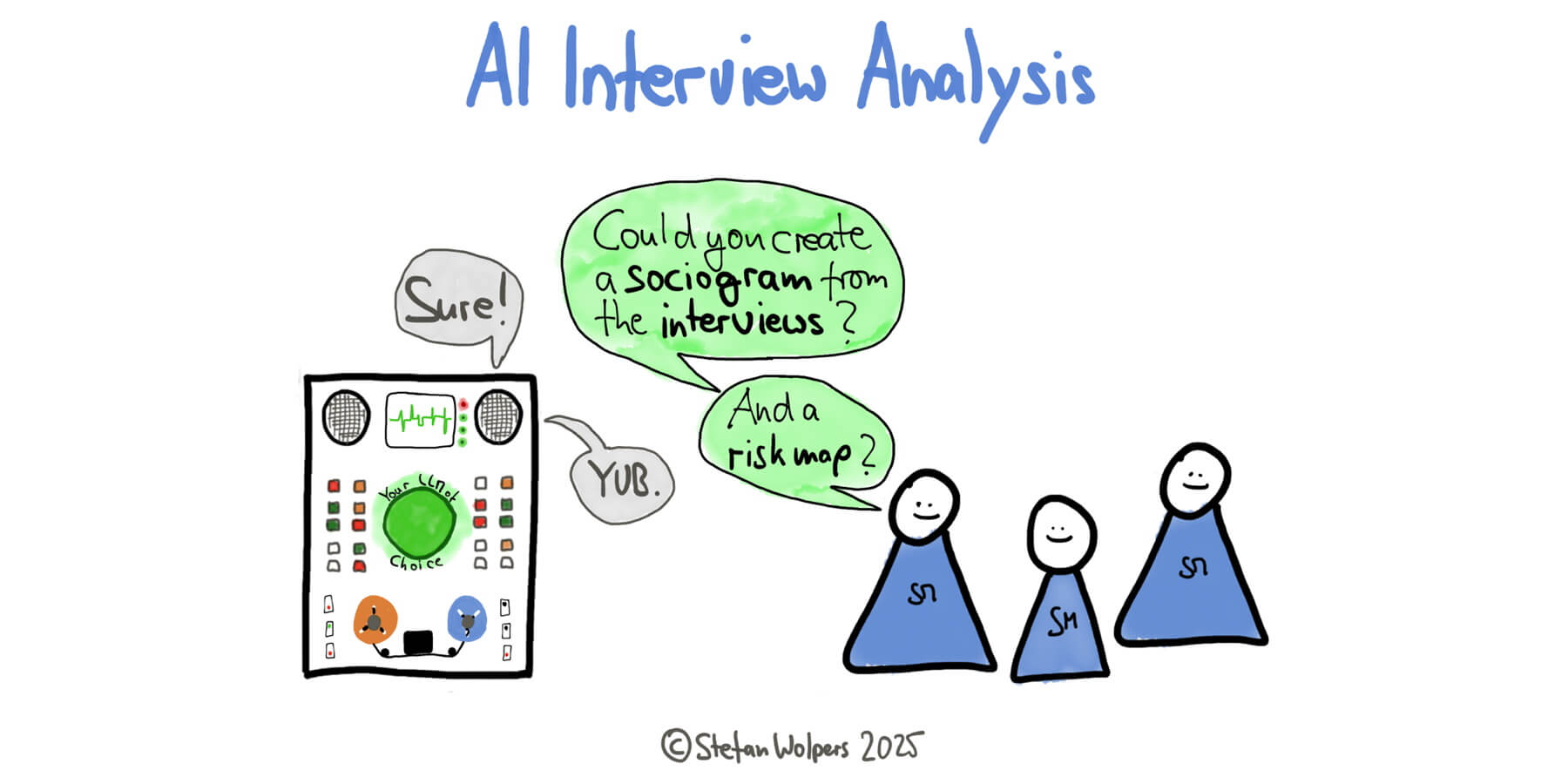
- Faster Trust Building: Recognizing and acknowledging specific challenges team members face—even those not explicitly brought to your attention—demonstrates empathy and builds trust more quickly. For example, Claude is excellent at creating sociograms and identifying isolated team members who need your help.
Practical Implementation: Using AI Interview Analysis as Your Sensemaking Partner
If you’re a Scrum Master or Agile Coach facing a similar challenge, here’s how to leverage generative AI effectively:
- Gather Diverse Input Data: Collect a variety of unstructured data sources, such as interview transcripts, Retrospective notes, meeting minutes, survey responses, and even Slack conversations, anonymized if appropriate. Please remember: the quantity of information or its inherent messiness is much less of a concern now.
- Create Effective Prompts: Your prompts to the AI should be specific and structured, addressing the use case, not just fishing around. Consider meta-prompting to support the task (see the Agile Prompt Engineering Framework above):
“Analyze these team interviews to identify:
– Common pain points mentioned across different roles,
– Contradictions in how different people describe priorities,
– Emotional indicators of team stress or burnout,
– Potential process improvements implied by the concerns raised.”
- Request Evidence-Based Analysis: Ask the AI to ground its observations in the data by providing examples, quotes, or patterns rather than making unsupported generalizations.
- Iteratively Refine Your Understanding: Use the AI’s initial analysis as a starting point, then ask follow-up questions to explore specific areas of interest or concern. You’ll need to talk with your AI buddy.
- Synthesize Your Understanding: Remember that AI is a thinking partner, not a replacement for your judgment. Use its output as input to your sensemaking process.
Ethical Considerations and Limitations
While leveraging AI for interview analysis offers significant benefits, it’s crucial to maintain awareness of its limitations:
- Privacy and Confidentiality: Ensure team members understand how their interview data will be used and processed.
- Compliance: Ensure that your approach meets your organization’s compliance standards.
- Verification is Essential: Always verify critical insights through direct conversation rather than relying solely on AI analysis. If you have any doubts, please ask the interviewees.
- AI Has Limitations: Current AI systems may miss subtle cultural nuances or specialized technical terminology. Also, remember that the customization of your AI account, your GPT (ChatGPT), your Gem (Gemini), or your Project (Claude) will affect the analysis!
- Human Judgment Remains Central: AI provides input to your thinking and is not a replacement for your coaching expertise.
Conclusion: AI as a Team Intelligence Ally
Generative AI offers Scrum Masters a powerful new tool for quickly understanding team dynamics when joining a new organization or project. By handling the initial cognitive heavy lifting of pattern recognition, AI allows you to focus your energy on building relationships and facilitating meaningful improvements where it matters most.
The goal isn’t to automate understanding—it’s to augment your natural coaching abilities by quickly surfacing patterns and connections that would take much longer to identify manually.
Your time is better spent coaching, facilitating, and connecting with team members than manually analyzing text. Let AI help with the heavy lifting so you can focus on what truly matters: supporting your team during challenging times.
The next time you’re faced with a stack of interviews and limited time, consider how generative AI might help you make sense of the situation more quickly and comprehensively than traditional methods alone.
PS: This sketched process also massively helps with customer interviews when you are in product management.
AI Interview Analysis — Recommended Reading
The Agile Prompt Engineering Framework
The Fantastic Optimus Alpha Approach to Data-Informed Retrospectives
AI in Agile Product Teams: Insights from Deep Research and What It Means for Your Practice
Is Vibe Coding Agile or Merely a Hype?
60 ChatGPT Prompts Plus Prompt Engineering Guide for Scrum Practitioners

Stefan Wolpers: The Scrum Anti-Patterns Guide (Amazon advertisement.)
Scrum Training Classes, Workshops, and Events
Learn more about the Lean Tech Manifesto with our Scrum training classes, workshops, and events. You can secure your seat directly by following the corresponding link in the table below:
See all upcoming classes here.

You can book your seat for the training directly by following the corresponding links to the ticket shop. If the procurement process of your organization requires a different purchasing process, please contact Berlin Product People GmbH directly.
✋ Do Not Miss Out and Learn more about AI Interview Analysis — Join the 20,000-plus Strong ‘Hands-on Agile’ Slack Community
I invite you to join the “Hands-on Agile” Slack Community and enjoy the benefits of a fast-growing, vibrant community of agile practitioners from around the world.

If you would like to join all you have to do now is provide your credentials via this Google form, and I will sign you up. By the way, it’s free.