TL; DR: Optimus Alpha Creates Useful Retrospective Format
In this experiment, OpenAI’s new stealthy LLM Optimus Alpha demonstrated exceptional performance in team data analysis, quickly identifying key patterns in complex agile metrics and synthesizing insights about technical debt, value creation, and team dynamics. The model provided a tailored Retrospective format based on real team data.
Its ability to analyze performance metrics and translate them into solid, actionable Retrospective designs represents a significant advancement for agile practitioners.
Shall I notify you about articles like this one? Awesome! You can sign up here for the ‘Food for Agile Thought’ newsletter and join 42,000-plus subscribers.
The AI-Enhanced Advanced Product Backlog Management Course Version 2—June 23, 2025
Are you facing problems aligning vision, stakeholders, your team, and delivering real value?
Is your contribution as a product leader questioned?
Then, prepare to transform your career with my AI-enhanced, comprehensive, self-paced online class. Dive deep into professional Product Backlog management techniques supported by videos, exercises, and the latest AI models.

Please note: The course will only be available for sign-up until June 30, 2025!
Join the Launch of the AI-Enhanced Version 2 on June 23: Learn How to Master the Most Important Artifact for any Successful Agile Practitioner!
The Rationale Behind Analyzing Team Data
In this conversation, I explored Optimus Alpha’s capabilities in analyzing team performance data and designing evidence-based Retrospectives. The exchange began with a familiar scenario: a Scrum team stuck in a “feature factory” mindset with stakeholders not embracing agile practices.
While Optimus Alpha initially provided a solid Retrospective format based on this limited information, the real test came when I introduced comprehensive team performance metrics from my AI for Agile Bootcamp cohort class.
The synthesized data of MegaBrain.io’s fictitious MB1 team includes metrics on technical debt, value creation, stakeholder satisfaction, and team autonomy across multiple sprints. This simulated dataset represented the complex reality many Scrum teams face—balancing predictability with technical health, stakeholder demands with value creation, and feature delivery with sustainability.
What follows is a remarkable demonstration of how Optimus Alpha absorbed this complex information, identified patterns that would typically require an experienced agile practitioner, and then transformed those insights into a tailored Retrospective design with supporting materials. The conversation showcases analytical power and the ability to convert data insights into practical tools for team improvement.
So, let’s get into the conversation with Optimus Alpha.
Analyzing the Team Data with the Help of Optimus Alpha
Round 1:
I ran this chat on OpenRouter.ai on April 12, 2025. “SW” refers to myself, “OP” to Optimus Alpha. The text is unedited to preserve its authenticity:
SW: My Scrum team has had a hard time; we are stuck in feature factory. Our Product Owner is little more than a Jira monkey, and no one is listening to me, the Scrum Master.
Can you suggest a Retrospective format my team can use to invite our stakeholders and help them understand that we could be more effective if we would only embrace agile practices?
OP: Absolutely, and thank you for sharing your challenge so openly—feature factory symptoms and disengaged roles are all too common. It’s great that you’re ready to create space for everyone, including stakeholders, to reflect and learn together.
Here’s a Retrospective format designed to include stakeholders and shift the conversation toward agile value, not just output:
Optimus Alpha — Retrospective Format #1: “From Feature Factory to Value Factory”
Aim: Help the whole group—team and stakeholders—reflect on how you work, see the costs of “just pushing features,” and imagine better ways of working together.
1. Setting the Stage (10 min)
- Welcome everyone, explain the purpose: “We want to reflect together on how we’re working—not just what we’re building—and explore ways to better create value for our customers and business.”
- Establish Working Agreements (respect, honesty, curiosity).
- Remind folks: retros are blameless.
2. The Metaphor: “Factory Floor” Visual (5 min)
- Draw a simple assembly line on a virtual board or whiteboard.
- On one side, put “Inputs” (ideas, requests), in the middle “Our Work,” outputting “Features.”
- Ask: “Where does customer value show up here?” (Get a few responses from both team and stakeholders.)
3. Group Activity: “What’s Working, What’s Not?” (15 min)
- Split everyone into breakout groups (mixed team & stakeholders).
- Each group answers:
- What do we do well right now?
- Where do we see pain, rework, or missed opportunities for value?
- Use sticky notes (digital or real), post answers on the board under “Working” and “Not Working.”
4. Share & Cluster Key Themes (10 min)
- In the main group, everyone shares stickies.
- Scrum Master (you!) clusters themes—often you’ll see “no time to validate with users,” “little feedback,” “unclear priorities,” etc.
5. Reflection—Are We Doing Agile, or Just Doing Stories? (5 min)
- Present the Agile Manifesto values or Scrum pillars briefly.
- Invite all: “Where are we supporting these values today? Where are we struggling?”
- Give a couple minutes for silent reflection, then discuss.
6. Co-create Experiments (10 min)
- In pairs (ideally stakeholder + team), brainstorm one small experiment for the next sprint that could address a pain point (ex: get quick user feedback, clarify value on one backlog item, joint story mapping session, etc).
- Each pair shares their idea briefly.
7. Closing & Commitments (5 min)
- Summarize: “If we want to escape feature factory mode, we all have a role.”
- Ask each participant: “What will I do differently next sprint?”
- Agree on 1–2 experiments to run, and how you’ll follow up.
Tips & Rationale
- Stakeholders see they’re part of the system—their requests, engagement, and feedback matter.
- Makes visible the costs of just shipping features (technical debt, missed value, burnout, lack of learning).
- Creates joint ownership for change—rather than feeling like the Scrum team is just “whining.”
Resources you might share:
Let me know if you want some invitation language for your stakeholders, or facilitation tips for handling tricky discussions!
Note SW: All links are correct topic-wise and technically although I had to add the title tags manually. Also, this is not just a good Retrospective—it’s a transformational opportunity if followed through. It reframes roles, builds bridges, and ignites reflection on what really matters. For a Feature Factory, it’s a worthwhile approach: small risk, huge potential upside.
Round 2:
SW: Do you need more information from me to improve your Retrospective suggestion?
OP: That’s a great offer—thank you! Here are some clarifying questions that could help me refine my suggestion, making it more targeted and actionable for your specific context:
1. Stakeholder Context
- Who are the stakeholders you want to include? (e.g., internal business partners, external clients, managers, VPs…)
- What do you think “they” understand about Agile or Scrum now?
- How engaged or disengaged are they in your team’s work or results?
2. Team Dynamics
- How large is your team? (size can affect activity facilitation)
- How long has your team been working in Scrum?
- How are your team members currently feeling about your process—frustrated, disengaged, burned out?
3. Pain Points & Symptoms
- Could you specify a couple of concrete “feature factory” symptoms you’re seeing? (e.g., relentless backlog churning, little feedback from users, no time for reflection/learning, missing sprint goals, etc.)
- Are there past attempts at improvement—or retros that didn’t land well?
4. Goals for the Retrospective
- What’s your top wish for the outcome? (e.g., awareness/education, spark for change, specific agreement on next steps)
- Are you hoping to target a specific agile practice or value (focus, transparency, collaboration, delivering value, etc.)?
5. Risk Appetite
- Would your group be open to a bit of “creative tension”—or do you need to be more diplomatic and gentle in surfacing issues?
The more context you can share, the more tailored (and likely effective) I can make the retrospective format—fitting your team’s culture, goals, and challenges. If you’d like, answer whichever of these jump out, or just share anything else you think is relevant!
Cannot see the form? Please click here.
SW: Before I answer your questions, please analyze the following team performance information and reconsider your questions. (Note: Here, I copied the synthesized team data from the Excel file into the context window.)
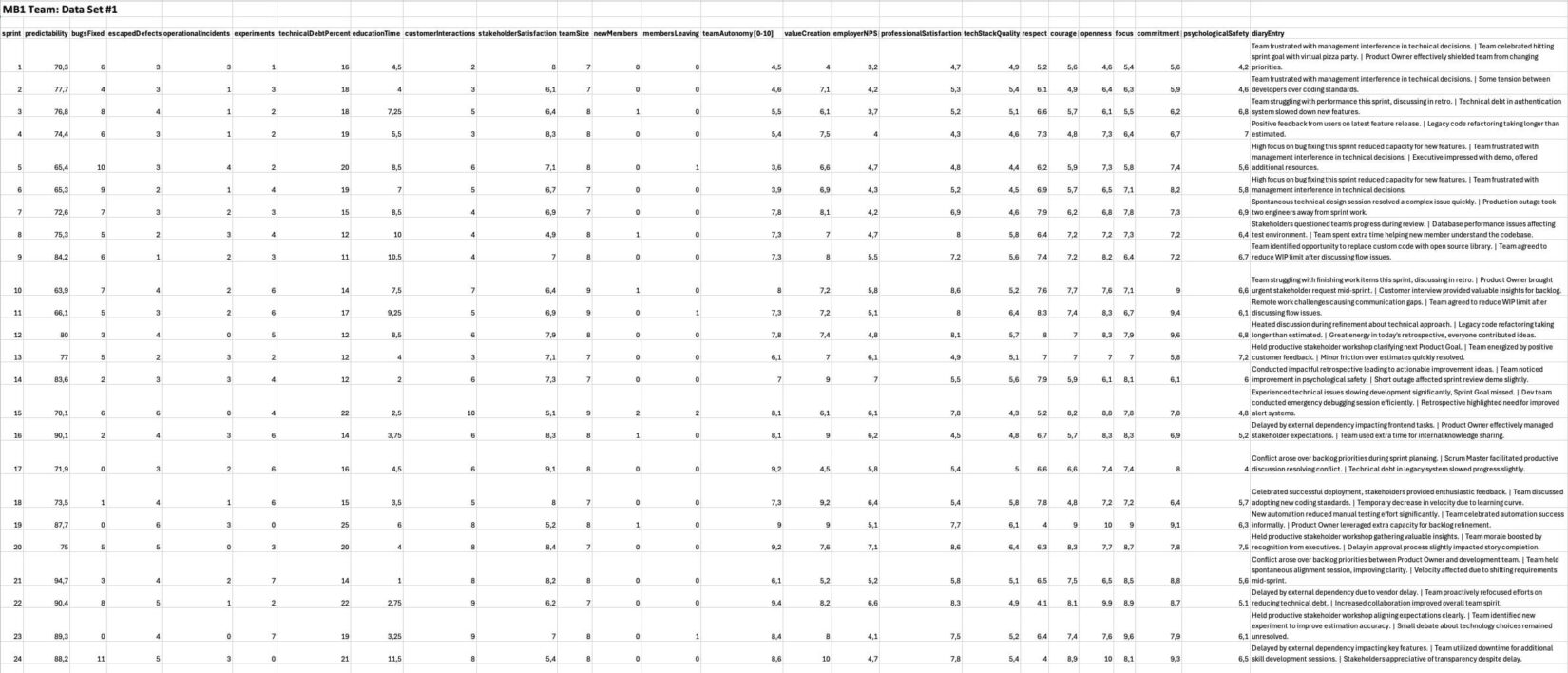
OP: Thank you for sharing this comprehensive team performance data. It gives a richer, more nuanced picture than any qualitative conversation alone. Before updating questions or tailoring my retrospective advice, here’s a quick analysis of key patterns:
Key Patterns & Insights
1. Feature Factory & Agile Health
- Experiments per sprint: Variable, sometimes 0, often 2–7 (average ~3–4), so the team is experimenting, but not always consistently.
- Technical Debt %: Frequently high (14–25%), showing this is a persistent drain, likely slowing new value delivery.
- Education Time: Fluctuates widely (as low as 1–2 hours, up to 11+), suggesting learning is sometimes deprioritized.
- Customer Interactions: Moderate, but not always present every sprint (often 3–10). Not bad, but more could drive value.
- Stakeholder Satisfaction: Mostly good, though dips into the 4–6 range sometimes with spikes to 9–10—indicative of variability.
2. Agile Values & Team Dynamics
- Scores on autonomy, value creation, NPS, professional satisfaction, psychological safety, courage, respect, openness, and focus; mostly trend between 5–9, but all dip into the 3–5 range at times—signaling periods of stress (see sprints 5–6, 15, etc.).
- Diary entries frequently mention:
- Management interference
- Technical debt slowing progress
- Positive retros/workshops that seem to spike morale/value scores
- Stakeholder tensions, executive pressure, and production outages
3. Other Patterns
- Predictability is high (60–90%) but that doesn’t always equate to satisfaction or value.
- Escaped defects, incidents, and new/lost team members are low: this is a stable team, but with recurring process pain.
What This Means for Your Retrospective
The Team is NOT “Just a Feature Factory”:
- There is some experimentation, customer contact, and educational investment.
- However, periods of “feature factory stress” (management interference, tech debt response mode, executive pressure) very clearly drive low scores in autonomy, satisfaction, and value creation.
When the Team Works Well:
- High autonomy and psychological safety, productive retros, stakeholder workshops, customer feedback => spike in both business and team satisfaction.
Biggest Opportunities:
- Consistent focus on value over pure output—variability is still high.
- Creating a more stable environment for learning, retrospection, and customer feedback, not just monthly or in “good times.”
- Better defense against management micromanagement and shifting priorities.
- Bridging perception with stakeholders—communicating value, not just throughput.
Revised Follow-Up Questions
With this data, fewer clarifying questions are needed, but I’ll tune them:
- What are your goals for the next retrospective, given these patterns?
- Awareness/education for stakeholders?
- Specific improvements (tech debt, stakeholder engagement, value focus)?
- Who do you want stakeholders to hear from?
- The team as a whole?
- Specific customer voices or data?
- Are there “untouchable” topics, or are you willing to openly discuss management interference and tech debt as a group?
- What timeframe do stakeholders care about most (week-to-week, quarterly outcomes, etc.)? How much appetite do they have for participating?
- In your view, which ONE success from the data is worth celebrating with stakeholders, and which ONE pain would you like to see acknowledged or solved?
If you answer even a couple of these, I can create a high-impact, data-driven retrospective format (perhaps even using this data as a visual centerpiece to spark joint learning and action among stakeholders and the team).
Would you like a sample format that incorporates this data as a mirror for your group? Or do you want to further discuss the questions above?
SW: Regarding your follow-up questions:
- Help the stakeholders understand that the team could create more value for customers and the organization if we leave the feature factory and embrace agile product development. It is about education, opportunities, trust building, overcoming technical debt.
- The team as a whole.
- No.
- At the moment, they are focused on the team meeting its commitments as defined in their year-long product roadmap; a problematic approach in a complex environment.
- Celebrate: High predictability despite the circumstances. Pain point: technical debt accumulation.
Please revise your suggested Retrospective format.
OP: Thank you for the clear answers! Here’s an improved Retrospective format tailored to your needs, data, and objective to educate and inspire stakeholders, shifting them from feature factory thinking to agile, value-driven product development.
Optimus Alpha — Retrospective Format #2: “Beyond Commitments: Building Lasting Value”
- Audience: Scrum Team & Stakeholders
- Duration: 60–75 minutes
- Goal: To build trust and educate stakeholders on how greater agility, autonomy, and focus on technical health can boost business value—beyond simply hitting features on a roadmap.
1. Welcome and Framing (5 min)
- “We’ve been very predictable, but our team sees even more potential for value—if we work together to modernize how we deliver.”
- Ground rules: curiosity, no blame, focus on opportunities.
- State purpose: “Let’s look at the real story our data tells, and find ways to unlock even more value for our customers and business.”
2. Celebrating Predictability (5 min)
- Show a simple chart of your team’s high predictability.
- Acknowledge: “We’re proud to honor commitments, despite challenges. That’s a real team achievement worth celebrating!”
3. Looking Deeper: The Value vs. Output Exercise (10 min)
- Show two simple graphs:
- a) Predictability (high, steady)
- b) Technical debt/Value creation/Stakeholder satisfaction (variable/fluctuating)
- Prompt: “What do you notice? What stories hide behind the numbers?”
- Invite both team and stakeholder reactions.
4. Short Team Stories: What’s the Cost of Feature Factory Living? (10 min)
- Team members each briefly share:
- A time when technical debt or backlog pressure forced a tradeoff.
- A time when autonomy/conversation with customers led to real value or insight.
- Ask: “What might have been possible, if we’d invested differently?”
5. Joint Brainstorm: Obstacles to Value (15 min)
- Use two columns (“What helps us create value” / “What blocks it?”)
- Team and stakeholders add stickies or notes.
- Common “blockers”: technical debt, rigid roadmaps, lack of room to learn or adapt, excessive management intervention.
- Common “helpers”: customer feedback, refactoring, team autonomy, experiments, stakeholder trust.
- Cluster and discuss. Highlight technical debt as the recurring pain point.
6. Opportunities for Change: Data-Driven Reflection (15 min)
- Show a visual of technical debt trend and its correlation with value creation or satisfaction (even rough/qualitative is fine: “Our biggest dips in value/satisfaction align with tech debt crunch periods…”)
- Prompt stakeholders:
- “If we could reduce tech debt and invest in technical health, what new doors might open?”
- “What would make you more confident to allow the team to explore, experiment, or adjust course?”
- “How might we move from only delivery, to creating value that lasts?”
7. Pick 1–2 Team + Stakeholder Experiments (10 min)
- Examples (modify as needed):
- Block 10% of time for tech debt/health work every sprint; review outcomes with stakeholders.
- Monthly customer feedback or “value alignment” review—invite a stakeholder to join.
- Jointly define what “real value” means for a sprint or feature.
- Hold quarterly review: “Is our roadmap still the highest-leverage way to deliver value?”
- Agree to try one or two for the next sprint/month.
8. Commitment Rounds & Closing (5 min)
- Each person (including stakeholders): “One thing I commit to do, say, or advocate for in service of value creation, not just feature delivery.”
- Thank everyone for honesty, curiosity, and partnership.
Facilitation Pointers:
- Use rich data visuals—a couple easy graphs (predictability, tech debt, value creation, satisfaction) spark honest discussion.
- Encourage the team to speak frankly about technical debt consequences.
- Invite stakeholders to reflect on what *they* would gain if the team could work with more agility and autonomy (“would we get to market faster, respond to changes better, attract and retain top talent?”).
- Model mutual respect: “Everyone here wants to deliver business value—but the path isn’t always just through features.”
Optional Pre-work
Consider sending the predictability and tech debt charts (and maybe a value creation graph) to stakeholders ahead of the session, with a note:
“We’re incredibly proud of our team’s reliability, yet we see a chance to unlock even more business value by working smarter. Looking forward to exploring this with you in our next session!”
Let me know if you want:
- Example data slide templates
- Stickies/board templates for Miro/Mural/Jamboard
- More story prompts for your team
This format will help you shift the conversation from mere throughput (“predictable factory”) to real, meaningful, sustainable value—for both customers and the business.
Note SW: The revised Retrospective format is an interesting outcome: Adding real team data helped shift our Retrospective from general discussion to focused conversations about what really affects results. Instead of just talking about feelings or processes, we looked at facts—like predictability, tech debt, and team satisfaction. This shift would make it easier for everyone, including stakeholders, to see where we are stuck and what is possible. It turned vague concerns, addressed by the first format, into clear opportunities for smarter decisions and better long-term outcomes.
This development perfectly reflects one of the outstanding capabilities of large language models: analyzing large quantities of data, identifying patterns within, and suggesting next steps. And Optimus Alpha proves to be really good at this.
Of course, I asked to deliver all of the before-mentioned artifacts only to be disappointed; Optimus Alpha could not deliver yet.
Conclusion — Optimus Alpha’s Retrospective Formats
Optimus Alpha’s ability to analyze team data and design targeted Retrospectives demonstrates the transformative potential of AI for agile practitioners. Tools like Optimus Alpha can help teams escape the feature factory trap and build more sustainable, value-focused ways of working by quickly identifying patterns in complex metrics and translating them into actionable formats.
The model’s insight into the relationship between technical debt and value creation, team autonomy, and stakeholder satisfaction provides evidence-based foundations for Retrospectives that might otherwise rely solely on subjective experiences. This approach represents a new frontier for data-informed facilitation—where LLMs serve as information processors and insightful partners in team improvement, easing communication with more data-oriented stakeholders.
As agile practices continue to evolve, the opportunity to augment your Retrospectives with AI-assisted data analysis could be game-changing: no more “gut-feeling-driven” change requests!
Have you experimented with analyzing team data using AI tools? How might an LLM like Optimus Alpha help you identify patterns in your team’s metrics that could inform more impactful retrospectives?
Please share your experiences and thoughts on how this approach might enhance your team’s journey toward greater business agility and sustainable value delivery.
Optimus Alpha — Recommended Reading
The Agile Prompt Engineering Framework
The Meta-Retrospective with Stakeholders — Check Out the Free Miroverse Template
21 Sprint Retrospective Anti-Patterns Impeding Scrum Teams
AI in Agile Product Teams: Insights from Deep Research and What It Means for Your Practice
Is Vibe Coding Agile or Merely a Hype?
60 ChatGPT Prompts Plus Prompt Engineering Guide for Scrum Practitioners

Stefan Wolpers: The Scrum Anti-Patterns Guide (Amazon advertisement.)
Scrum Training Classes, Workshops, and Events
Learn more about the Lean Tech Manifesto with our Scrum training classes, workshops, and events. You can secure your seat directly by following the corresponding link in the table below:
See all upcoming classes here.

You can book your seat for the training directly by following the corresponding links to the ticket shop. If the procurement process of your organization requires a different purchasing process, please contact Berlin Product People GmbH directly.
✋ Do Not Miss Out and Learn more about Optimus Alpha — Join the 20,000-plus Strong ‘Hands-on Agile’ Slack Community
I invite you to join the “Hands-on Agile” Slack Community and enjoy the benefits of a fast-growing, vibrant community of agile practitioners from around the world.

If you would like to join all you have to do now is provide your credentials via this Google form, and I will sign you up. By the way, it’s free.